|
 |
 |
 |
 |
 |
 |
 |
 |
 |

| . |  |
. |
The Shenzhou Olympics
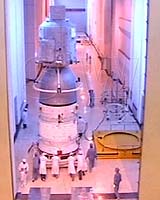
Melbourne, Australia (SPX) Mar 13, 2006 After a flurry of media statements, the latest wave of official Shenzhou publicity seems to be drawing to a close. China has now mapped out plans for its next four launches in the Shenzhou program, and has clarified details on the next flight. But one plausible conclusion seems to have escaped most reports in the aerospace media. The flight of Shenzhou 7 could be timed to coincide with the Beijing Olympics. Plans for the 2008 Summer Olympics call for the events to be held between the 8th and 24th of August in that year. It's reasonable to expect that China will use the event to promote its achievements before the world, and human spaceflight is arguably China's most significant recent breakthrough. The 2004 Athens Olympics included a video greeting from the International Space Station during the opening ceremony, and a ceremonial torch for the 2000 Sydney games was flown in space aboard the US Space Shuttle. The precedent for including spaceflight into the Olympics has already been set. But so far, no nation has incorporated a space mission and an Olympic game in their own territory at the same time. Shenzhou 7, China's next manned space mission, was originally advertised for 2007. This fit into the pattern of staging a two-year gap between crewed Shenzhou missions, which have previously launched in 2003 and 2005. But Chinese media statements have recently amended this to 2008. Chinese media have reported that while the overall program is going well, more time is needed to work on the spacesuit that will be used on this flight to stage China's first spacewalk. It's possible that Chinese engineers want to give themselves some extra leeway for this complex mission, but the timings given in the media seem suspiciously coincidental. Shenzhou missions normally launch in October. In fact, Shenzhous 5 and 6 launched within three days of each other during this month. There's an obvious consistency of planning here, and we can expect that Shenzhhou 7 was originally slated for mid-October, 2007. China has since stated that the launch will be delayed "by about half a year" to 2008. This suggests a launch that could appear just weeks before the opening ceremony of the Beijing Olympics. China could intend to carry out the mission of Shenzhou 7 just as media attention is focused on the lead-up to the Olympics. The crew of the flight, and possibly China's other flown astronauts, could then be paraded during the opening ceremony. China has previously feted her space travellers in stadium-based celebrations, such as the Hong Kong event that saw Yang Liwei singing with actor Jacky Chan. Such theatrics could be replicated again. China has also suggested that the extravehicular activity will be carried out by a single astronaut, and has indicated that half an hour is a rough estimate of the planned time for the spacewalk. Your correspondent speculated that this would be the rough time and EVA crew size in a previous article, based on the early EVA experiments of the Soviet and American programs. China is apparently following suit, probably for the same reasons of conservative mission planning and safety. Dr Morris Jones is a lecturer at Deakin University, Australia Related Links Learn about the Chinese Space Program at Dragon Space  Aerospace Expert Calls For Unified Management Of Space Program
 Beijing, China (XNA) Mar 09, 2006
China should set up a governmental agency as a leading body of the nation's space program, a former chief designer of spacecraft said during the annual session of the country's top political advisory body. |
|
|

| The content herein, unless otherwise known to be public domain, are Copyright 1995-2006 - SpaceDaily.AFP and UPI Wire Stories are copyright Agence France-Presse and United Press International. ESA PortalReports are copyright European Space Agency. All NASA sourced material is public domain. Additionalcopyrights may apply in whole or part to other bona fide parties. Advertising does not imply endorsement,agreement or approval of any opinions, statements or information provided by SpaceDaily on any Web page published or hosted by SpaceDaily. Privacy Statement |