|
 |
 |
 |
 |
 |
 |
 |
 |
 |

| . |  |
. |
The Slowest And Fastest Train In The Universe
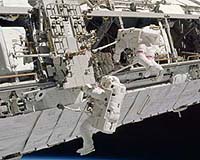
Houston - Mar 26, 2004 The Mobile Transporter is the slowest and fastest train in the universe, at the same time. How can that be? It's all in the details. The Mobile Transporter (MT) runs along a railway on the outside of the International Space Station (ISS). Once completed, the railway will stretch about 278 feet along the outside of the Station. As it moves down the track, the train's top speed is about 1 inch per second. It is usually operated by flight controllers in Mission Control on the ground, but the Station crew could also operate it if needed. The MT isn't a passenger train, since it only hauls equipment. The astronauts move along the railway during space walks by using special handcarts called the Crew and Equipment Translation Aids. As part of the Mobile Servicing System, the MT moves a robotic arm so it can help build large structures. Originally, the robotic arm, called Canadarm 2, stayed in one place and could extend about 50 feet to work on projects. As the Space Station has grown, the reach of the robotic arm was too short to access all areas of the ISS. By being able to move the arm from one end of the Station to another, the astronauts will be able to use the arm on many more sections, including installing new pieces that will lengthen the railway. The transporter weighs 1,950 pounds and is built from thick aluminum and titanium. In space, though, a vehicle that large still risks floating off the tracks because of microgravity. To prevent the MT from separating from the ISS, the train is kept on the tracks using wheels under and above the tracks, similar to a suspension roller coaster ride at an amusement park. The MT may be large, but it works with great precision and accuracy. Magnetic sensors help the vehicle stop exactly where it's supposed to - within 1/10-inch - so that all power sources and openings can meet in exactly the right location. Even the most accurate vehicle can't do its job if something goes wrong, so the MT is built with double redundancy in almost every component. Double redundancy means that a backup system is in place to take over if the first method fails. The Mobile Transporter has double motors installed, so that if the first one fails, it's not stuck out there on the track with astronauts unable to make a repair. So how can something that moves just 1 inch per second be faster than a speeding train here on Earth? It's all in the MT's location. Merely being attached to the ISS means that it's orbiting the Earth at the same speed as the Space Station: 17,500 miles per hour. The Silver Bullet, the fastest train on Earth, only travels at 186 mph! Related Links SpaceDaily Search SpaceDaily Subscribe To SpaceDaily Express  These Boots Are Made For Walking
 Houston - Mar 16, 2004
How will future space suits differ from the current ones? Well, for one thing, the boots will be made for walking. Astronauts who wear space suits for extra-vehicular activities (EVAs) don't walk. They hover and float, or their feet are placed into foot restraints so they don't drift away. In the future, however, astronauts may go to Mars as part of NASA's new vision. And they'll need very different boots to walk on the planet's surface or drive a rover. |
|
|

| The content herein, unless otherwise known to be public domain, are Copyright 1995-2006 - SpaceDaily.AFP and UPI Wire Stories are copyright Agence France-Presse and United Press International. ESA PortalReports are copyright European Space Agency. All NASA sourced material is public domain. Additionalcopyrights may apply in whole or part to other bona fide parties. Advertising does not imply endorsement,agreement or approval of any opinions, statements or information provided by SpaceDaily on any Web page published or hosted by SpaceDaily. Privacy Statement |