
 |
 |
 |
 |
 |
 |
 |
 |
 |
 |

| . |  |
. |
The Sun Shows Signs Of Life
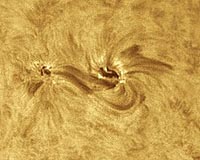
Science@NASA Huntsville AL (SPX) Nov 10, 2008 After two-plus years of few sunspots, even fewer solar flares, and a generally eerie calm, the sun is finally showing signs of life. "I think solar minimum is behind us," says sunspot forecaster David Hathaway of the NASA Marshall Space Flight Center. His statement is prompted by an October flurry of sunspots. "Last month we counted five sunspot groups," he says. That may not sound like much, but in a year with record-low numbers of sunspots and long stretches of utter spotlessness, five is significant. "This represents a real increase in solar activity." Even more significant is the fact that four of the five sunspot groups belonged to Solar Cycle 24, the long-awaited next installment of the sun's 11-year solar cycle. "October was the first time we've seen sunspots from new Solar Cycle 24 outnumbering spots from old Solar Cycle 23. It's a good sign that the new cycle is taking off." Old Solar Cycle 23 peaked in 2000 and has since decayed to low levels. Meanwhile, new Solar Cycle 24 has struggled to get started. 2008 is a year of overlap with both cycles weakly active at the same time. From January to September, the sun produced a total of 22 sunspot groups; 82% of them belonged to old Cycle 23. October added five more; but this time 80% belonged to Cycle 24. The tables have turned. At first glance, old- and new-cycle sunspots look the same, but they are not. To tell the difference, solar physicists check two things: a sunspot's heliographic latitude and its magnetic polarity. (1) New-cycle sunspots always appear at high latitude, while old-cycle spots cluster around the sun's equator. (2) The magnetic polarity of new-cycle spots is reversed compared to old-cycle spots. Four of October's five sunspot groups satisfied these two criteria for membership in Solar Cycle 24. The biggest of the new-cycle spots emerged at the end of the month on Halloween. Numbered 1007, or "double-oh seven" for short, the sunspot had two dark cores each wider than Earth connected by active magnetic filaments thousands of kilometers long. On Nov. 3rd and again on Nov. 4th, double-oh seven unleashed a series of B-class solar flares. Although B-flares are considered minor, the explosions made themselves felt on Earth. X-rays bathed the dayside of our planet and sent waves of ionization rippling through the atmosphere over Europe. Hams monitoring VLF radio beacons noticed strange "fades" and "surges" caused by the sudden ionospheric disturbances. Hathaway tamps down the excitement: "We're still years away from solar maximum and, in the meantime, the sun is going to have some more quiet stretches." Even with its flurry of sunspots, the October sun was mostly blank, with zero sunspots on 20 of the month's 31 days. But it's a start. Stay tuned for solar activity. Share This Article With Planet Earth
Related Links Science@NASA Solar Science News at SpaceDaily
 Magnetic Portals Connect Sun And Earth
 Huntsville AL (SPX) Oct 31, 2008
During the time it takes you to read this article, something will happen high overhead that until recently many scientists didn't believe in. A magnetic portal will open, linking Earth to the sun 93 million miles away. Tons of high-energy particles may flow through the opening before it closes again, around the time you reach the end of the page. |
|
|

| The content herein, unless otherwise known to be public domain, are Copyright 1995-2007 - SpaceDaily.AFP and UPI Wire Stories are copyright Agence France-Presse and United Press International. ESA Portal Reports are copyright European Space Agency. All NASA sourced material is public domain. Additional copyrights may apply in whole or part to other bona fide parties. Advertising does not imply endorsement,agreement or approval of any opinions, statements or information provided by SpaceDaily on any Web page published or hosted by SpaceDaily. Privacy Statement |
 del.icio.us
 Digg
Digg Reddit
 YahooMyWeb
 Google
 Facebook