|
 |
 |
 |
 |
 |
 |
 |
 |
 |

| . |  |
. |
The eta Aquarid Meteor Shower
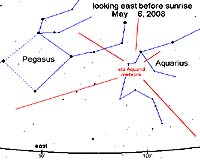
Washington DC (SPX) May 05, 2008 The eta Aquarid meteor shower peaks this year on Tuesday, May 6th. The best time to look, no matter where you live, is during the hours immediately before sunrise. If you can, get away from city lights; you will see more meteors from the dark countryside. 2008 should be a good year for the eta Aquarid meteors. The Moon is new, which means no lunar glare, and Earth is expected to pass through an unusually dense region of comet dust, driving meteor rates as high as 70 per hour in the southern hemisphere. Sky watchers in Australia, New Zealand, South America and southern Africa are favored. It is possible to see the shower from the northern hemisphere, too, but rates are reduced to less than 30 per hour. The eta Aquarids are flakes of dust from Halley's Comet, which last visited Earth in 1986. Although the comet is now far away, beyond the orbit of Uranus, it left behind a stream of dust. Earth passes through the stream twice a year in May and October. In May we have the eta Aquarid meteor shower, in October the Orionids. Both are caused by Halley's Comet. The eta Aquarids are named after a 4th-magnitude star in the constellation Aquarius. The star has nothing to do with the meteor shower except that, coincidentally, meteors appear to emerge from a point nearby. Eta Aquarii is 156 light years from Earth and 44 times more luminous than the Sun. The constellation Aquarius does not rise very far above the horizon in the northern hemisphere, and that's why northerners see relatively few meteors. But the ones they do see could be spectacular Earthgrazers. Earthgrazers are meteors that skim horizontally through the upper atmosphere. They are slow and dramatic, streaking far across the sky. The best time to look for Earthgrazers is between 2:00 to 2:30 a.m. local time when Aquarius is just peeking above the horizon. Experienced meteor watchers suggest the following viewing strategy: Dress warmly. Bring a reclining chair, or spread a thick blanket over a flat spot of ground. Lie down and look up somewhat toward the east. Meteors can appear in any part of the sky, although their trails will point back toward Aquarius. Tidbits: - Eta Aquarid meteoroids hit Earth's atmosphere traveling 66 km/s. - Typical eta Aquarid meteors are as bright as a 3rd magnitude star. Community Email This Article Comment On This Article Related Links spaceweather.com Asteroid and Comet Impact Danger To Earth - News and Science
 Canadian satellite to detect Earth hits
 Ottawa (UPI) May 2, 2008
 Canadian researchers are working on a tiny satellite that will alert the world to the potential of asteroid strikes. |
|
|

| The content herein, unless otherwise known to be public domain, are Copyright 1995-2007 - SpaceDaily.AFP and UPI Wire Stories are copyright Agence France-Presse and United Press International. ESA Portal Reports are copyright European Space Agency. All NASA sourced material is public domain. Additional copyrights may apply in whole or part to other bona fide parties. Advertising does not imply endorsement,agreement or approval of any opinions, statements or information provided by SpaceDaily on any Web page published or hosted by SpaceDaily. Privacy Statement |