
Subscribe free to our newsletters via your
. Military Space News .


WATER WORLD
The structural memory of water persists on a picosecond timescale
by Staff Writers
Amsterdam, The Netherlands (SPX) Sep 22, 2015


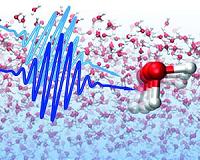
The lifetime of local water structures is probed using ultrafast laser pulses. Image courtesy Yuki Nagata / MPI-P. For a larger version of this image please go here.

A team of scientists from the Max Planck Institute for Polymer Research (MPI-P) in Mainz, Germany and FOM Institute AMOLF in the Netherlands have characterized the local structural dynamics of liquid water, i.e. how quickly water molecules change their binding state. Using innovative ultrafast vibrational spectroscopies, the researchers show why liquid water is so unique compared to other molecular liquids. This study has recently been published in the scientific journal Nature Communications.

With the help of a novel combination of ultrafast laser experiments, the scientists found that local structures persist in water for longer than a picosecond, a picosecond (ps) being one thousandth of one billionth of a second (10-12 s). This observation changes the general perception of water as a solvent. "71% of the earth's surface is covered with water.

As most chemical and biological reactions on earth occur in water or at the air water interface in oceans or in clouds, the details of how water behaves at the molecular level are crucial. Our results show that water cannot be treated as a continuum, but that specific local structures exist and are likely very important" says Mischa Bonn, director at the MPI-P.

Water is a very special liquid with extremely fast dynamics. Water molecules wiggle and jiggle on sub-picosecond timescales, which make them undistinguishable on this timescale. While the existence of very short-lived local structures - e.g. two water molecules that are very close to one another, or are very far apart from each other - is known to occur, it was commonly believed that they lose the memory of their local structure within less than 0.1 picoseconds.

The proof for relatively long-lived local structures in liquid water was obtained by measuring the vibrations of the Oxygen-Hydrogen (O-H) bonds in water. For this purpose the team of scientists used ultrafast infrared spectroscopy, particularly focusing on water molecules that are weakly (or strongly) hydrogen-bonded to their neighboring water molecules.

The scientists found that the vibrations live much longer (up to about 1 ps) for water molecules with a large separation, than for those that are very close (down to 0.2 ps). In other words, the weakly bound water molecules remain weakly bound for a remarkably long time.


Thanks for being here;
We need your help. The Space Media Network continues to grow but revenues have never been harder to maintain.

With the rise of Ad Blockers, and Facebook - our traditional revenue sources via quality network advertising continues to decline. And unlike so many other news sites, we don't have a paywall - with those annoying usernames and passwords.

Our news coverage takes time and effort to publish 365 days a year.

If you find our news sites informative and useful then please consider becoming a regular supporter or for now make a one off contribution.
SpaceMediaNetwork Contributor
$5 Billed Once


credit card or paypal
SpaceMediaNetwork Monthly Supporter
$5 Billed Monthly


paypal only


.


Related Links
Max Planck Institute for Polymer Research
Water News - Science, Technology and Politics


Comment on this article via your Facebook, Yahoo, AOL, Hotmail login.

Share this article via these popular social media networks
del.icio.usdel.icio.us DiggDigg RedditReddit GoogleGoogle


Memory Foam Mattress Review
Newsletters :: SpaceDaily :: SpaceWar :: TerraDaily :: Energy Daily
XML Feeds :: Space News :: Earth News :: War News :: Solar Energy News


WATER WORLD
Study reveals need for better understanding of water use
West Lafayette IN (SPX) Sep 14, 2015
A new study reveals a pressing need to better understand water use in America's rivers, with implications for drought-stricken regions of the country. Findings from the study showed that virtually all of the water entering the Wabash River in Indiana during summer months is withdrawn and then returned to the waterway. "In a nutshell, in the summertime we generally use what is equival ... read more


WATER WORLD
Russian Anti-Missile Warning System Protects on Multiple Tiers

Russian Missile Warning System Can Detect Mass Launch of Ballistic Missiles

US runs missile defense wargames to break Russian jamming

Japan requests Aegis systems for new destroyers

WATER WORLD
Orbital ATK producing more AARGM missiles

Advanced Sidewinder missile approved for full-rate production

Moscow, Tehran Sign Roadmap For S-300 Deal Implementation

Air-launched Sidewinder tested as ground-based weapon

WATER WORLD
British Military to Buy Solar-Powered Drones Flying on Edge of Space

Drones Are Now Being Used To Stop Rhino Poachers In Their Tracks

US Tests New Cerberus Electronic Attack System on Drones

To Watch and to Strike: Russia Developing Multi role Heavy Drone

WATER WORLD
BAE Systems modernizing Australia's military communications

GSAT-6 military satellite put in its orbital slot

45th SW supports 4th Mobile User Objective System satellite launch

Navy extends satellite support contract

WATER WORLD
U.S. Army orders anti-armor weapon from Saab

Australia funds military technology development

Netherlands orders Excalibur IB artillery rounds

AM General wins Humvee contract

WATER WORLD
Mega arms fair met with protest in Britain

U.S. defense industry pushes Congress for budget deal

Lockheed Martin protests new armored truck contract

Middle Eastern leaders flood to Moscow for Syrian talks, aerospace salon

WATER WORLD
Japan scrambles jets to intercept 'Russian' plane

Dutch boosts defence spending

Americans await earful from Pope Francis

USAFE commander warns of Russia's growing air power

WATER WORLD
Nanoelectronics could get a boost from carbon research

Nano-trapped molecules are potential path to quantum devices

Science provides new way to peer into pores

Realizing carbon nanotube integrated circuits


The content herein, unless otherwise known to be public domain, are Copyright 1995-2014 - Space Media Network. All websites are published in Australia and are solely subject to Australian law and governed by Fair Use principals for news reporting and research purposes. AFP, UPI and IANS news wire stories are copyright Agence France-Presse, United Press International and Indo-Asia News Service. ESA news reports are copyright European Space Agency. All NASA sourced material is public domain. Additional copyrights may apply in whole or part to other bona fide parties. Advertising does not imply endorsement, agreement or approval of any opinions, statements or information provided by Space Media Network on any Web page published or hosted by Space Media Network. Privacy Statement All images and articles appearing on Space Media Network have been edited or digitally altered in some way. Any requests to remove copyright material will be acted upon in a timely and appropriate manner. Any attempt to extort money from Space Media Network will be ignored and reported to Australian Law Enforcement Agencies as a potential case of financial fraud involving the use of a telephonic carriage device or postal service.