|
 |
 |
 |
 |
 |
 |
 |
 |
 |

| . |  |
. |
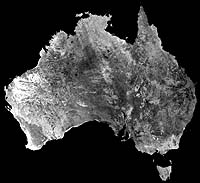
Three Continents Collide To Create Australia
Adelaide, Australia (SPX) Aug 17, 2006 A PhD student in the University of Adelaide's School of Earth and Environmental Sciences has found evidence of a collision between northern and central Australia 1.64 billion years ago. Kate Selway says that two billion years ago, the Australia we know today existed only in bits. "Northern, western and central Australia all belonged to different continents. New research is shedding light on how these pieces may have come together and the information could be significant to the discovery of new mineral deposits," Ms Selway says. Using a geophysical technique called magnetotellurics, which measures the electrical conductivity of the Earth to depths of hundreds of kilometres, Ms Selway has been probing the Earth beneath central Australia. She found that northern Australia is more conductive than central Australia, and that the boundary between them extends to at least 150 km in depth. "If you looked south from Alice Springs before 1.64 billion years ago, you would have seen an ocean," Ms Selway says. "The huge forces involved in this collision produced volcanoes which actually helped create the crust of central Australia." Many ancient structures in Australia, such as this collision zone, are hidden to traditional geological probes by thick layers of younger sediment. But Ms Selway says finding these structures by using methods which can penetrate the sediment is vital. "Not only does this kind of information help us to understand how our continent formed, it can also be fundamental in finding the next big mineral deposit. Such structures play an important role in determining how fluids move under the surface - and it is these fluids which often carry the metals that can concentrate into valuable mineral deposits." Kate Selway is one of 16 young scientists presenting their research to the public for the first time thanks to Fresh Science, a national program sponsored by the Federal and Victorian Governments. One of the Fresh Scientists will win a trip to the UK courtesy of British Council Australia to present his or her work to the Royal Institution. The research was carried out in collaboration between the University of Adelaide and the Northern Territory Geological Survey. Ms Selway was supervised in her PhD by Associate Professor Graham Heinson and Associate Professor Martin Hand from the School of Earth and Environmental Sciences. Related Links Explore The Earth Earth at TerraDaily.com  The Building Blocks Of Earth Are Iron
 San Antonio TX (SPX) Feb 20, 2006
Iron meteorites are probably the surviving fragments of the long-lost asteroid-like bodies that formed the Earth and other nearby rocky planets, according to researchers from Southwest Research Institute (SwRI) and Observatoire de la Cote d'Azur in Nice, France. Their findings are described in the Feb.16 issue of Nature. |
|
|

| The content herein, unless otherwise known to be public domain, are Copyright 1995-2006 - SpaceDaily.AFP and UPI Wire Stories are copyright Agence France-Presse and United Press International. ESA PortalReports are copyright European Space Agency. All NASA sourced material is public domain. Additionalcopyrights may apply in whole or part to other bona fide parties. Advertising does not imply endorsement,agreement or approval of any opinions, statements or information provided by SpaceDaily on any Web page published or hosted by SpaceDaily. Privacy Statement |