
 |
 |
 |
 |
 |
 |
 |
 |
 |
 |

| . |  |
. |
Throwing Light On The Dark Side Of The Universe
Basque Country, Spain (SPX) Oct 22, 2008 Although we may believe humans know a lot about the Universe, there are still a lot of phenomena to be explained. A team of cosmologists from the University of the Basque Country are searching for the model that best explains the evolution of the Universe. We usually have an image of scientists who study the Universe doing so peering through a telescope. And, effectively, this is what astrophysicists de: gather data about the observable phenomena of the Universe. However, in order to interpret this data, i.e. to explain the majority of the phenomena occurring in the Universe, complicated calculations with a computer are required and which have to be based on appropriate mathematical models. This is what the Gravitation and Cosmology research team at the University of the Basque Country (UPV/EHU) is involved in: analysing models capable of explaining the evolution of the Universe.
Supernovas, witnesses to acceleration Supernovas are very brilliant stellar explosions that, precisely due to this, provide useful data for exploring very distant regions of the Universe. By measuring the quantity of light that gets to us from a supernova, we can calculate its distance from us, and its colour indicates the speed at which it is distancing itself from us - the more reddish it is, the faster it is travelling. In other words, comparing two supernovas, the one that is distancing itself more slowly from us is a more bluish colour. According to observations by astrophysiscists, besides supernovas distancing themselves from us, they are doing so more and more rapidly, i.e. distancing themselves at an accelerated velocity, just like the rest of the material of the Universe.
Looking for dark energy The dark energy debate is not just any theory: its existence has not been proved but, without it, standard models of physics would not be able to explain many of the phenomena occurring in the Universe. So, what is dark energy exactly? What are its characteristics and have these properties always been the same or have they changed over time? These are questions, amongst others, that researchers at the Faculty of Science and Technology at the UPV/EHU, under the direction of Dr. Alexander Feinstein, are seeking to answer. The unique characteristic of dark energy known to us is that it possesses repulsive gravitational force. That is, unlike the gravity we know on Earth, this force tends to distance stars, galaxies and the rest of the structures of the Universe from each other. This would explain why the expansion of the Universe is not constant, but accelerated. Nevertheless, this phenomenon can only be detected when achieving observationally enormous, almost unimaginable distances. This is why it is so difficult to understand the nature of dark energy.
The theory of phantom energy This research group considers that the phantom energy model may be the most suitable to explain the accelerated expansion of the Universe. Amongst other things, the team has come to this conclusion after analysing the distribution of galaxies and the background microwave radiation which has inundated all of the Cosmos since shortly after the Big Bang. These waves travel in every direction and enable the exploration of what occurred at tremendously remote instants in time, moments close to the start of it all. Community Email This Article Comment On This Article Share This Article With Planet Earth
Related Links University of the Basque Country Stellar Chemistry, The Universe And All Within It
 Powerful Nearby Supernova Caught By Web Of Telescopes
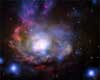 Paris, France (ESO) Oct 02, 2008
Over a decade after it exploded, one of the nearest supernovae in the last 25 years has been identified. This result was made possible by combining data from the vast online archives from many of the world's premier telescopes. |
|
|

| The content herein, unless otherwise known to be public domain, are Copyright 1995-2007 - SpaceDaily.AFP and UPI Wire Stories are copyright Agence France-Presse and United Press International. ESA Portal Reports are copyright European Space Agency. All NASA sourced material is public domain. Additional copyrights may apply in whole or part to other bona fide parties. Advertising does not imply endorsement,agreement or approval of any opinions, statements or information provided by SpaceDaily on any Web page published or hosted by SpaceDaily. Privacy Statement |
 del.icio.us
 Digg
Digg Reddit
 YahooMyWeb
 Google
 Facebook