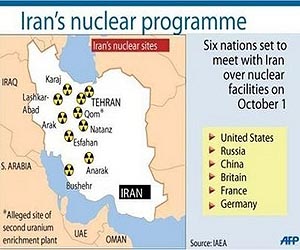
Iran and world powers cannot afford to come away from their next round of nuclear talks in Moscow in June without concrete progress, as they did in Baghdad, analysts said on Friday.
"We are starting to reach a point in which it is going to be more difficult to keep this process alive without having some tangible results on the substantive issues," said Trita Parsi, author of a recent book about US diplomacy with Iran called "A Single Roll of the Dice."
With an EU embargo on Iranian oil set to come into force on July 1, two weeks after the next meeting in the Russian capital on June 18-19, Iran in particular cannot afford to keep avoiding the key issues indefinitely.
But the pressure is also on the P5+1, as the group comprising Germany and the five permanent and nuclear-armed members of the UN Security Council — Russia, the United States, China, Britain and France — is known.
Israel, the region's sole if undeclared nuclear power, has like Washington not ruled out military action to prevent its arch foe also getting the bomb and has made clear its patience with diplomacy is running out.
US President Barack Obama wants to bring down oil prices to help the economy as he seeks re-election on November, although at the same time he is wary of being accused of weakness towards Iran by his Republican challenger.
Parsi said he had expected this week's meeting to be a "calculated failure in the sense that both sides will drive a very hard bargain, knowing they have a chance of having another meeting before these other sanctions kick in."
"They could afford to do this (in Baghdad), but I don't know if they can afford to do this in Moscow," he said.
In intense discussions in Baghdad this week, the good mood music hailed by all at an initial gathering in Istanbul in mid-April, the first in 15 months, fell silent as negotiators got down to the real issues.
"Baghdad began with a giant leap backward as a result of an obstinate non-flexible Western approach and ended as a small step forward by the agreement to continue in Moscow," said Kaveh Afrasiabi, former adviser to Iranian nuclear negotiation teams from 2004-06.
The main bone of contention was — and will remain in Moscow — the speed at which the P5+1 eases sanctions if the Islamic republic suspends the parts of its nuclear programme that most raise suspicions it wants an atomic arsenal.
This is the enrichment of uranium to purities of 20 percent, a capability that in theory cuts the "breakout" time needed to develop the fissile core of a nuclear weapon if Tehran took the decision to build the bomb.
Iran's negotiator Saeed Jalili said in Baghdad that this "can be an issue of discussion for cooperation" and that EU foreign policy chief Catherine Ashton said Iran had "declared its readiness to address" the topic.
But Mark Fitzpatrick from the International Institute for Strategic Studies think-tank in London told AFP that Iran's expectations going into the talks of what the P5+1 would offer were "wildly inflated."
Ashton's proposals on behalf of the six called on Iran to suspend 20-percent enrichment but she did not dangle the carrot of easing sanctions that Iran had wanted in return for giving up what Jalili called Tehran's "inalienable right."
Instead she reportedly offered measures such as supplying fuel for producing medical isotopes, technical assistance, easing restrictions on aircraft parts and a suspension of an EU insurance ban on ships carrying Iranian oil.
Mark Hibbs, nuclear proliferation expert at the Carnegie Foundation for International Peace, said there was a "window" open for both sides to strike a deal but that this would require more "brinkmanship."
But he told AFP that part of the problem was that it is unclear that Iran's supreme leader, Ayatollah Ali Khamenei, "can simply cut a deal without precipitating an internal political crisis."
He added that the role of the UN atomic agency, the International Atomic Energy Agency (IAEA), would be "crucial" in order to "provide the world with confidence that Iran's nuclear programme is totally peaceful."