|
 |
 |
 |
 |
 |
 |
 |
 |
 |

| . |  |
. |
Time In Space Has Many Endings
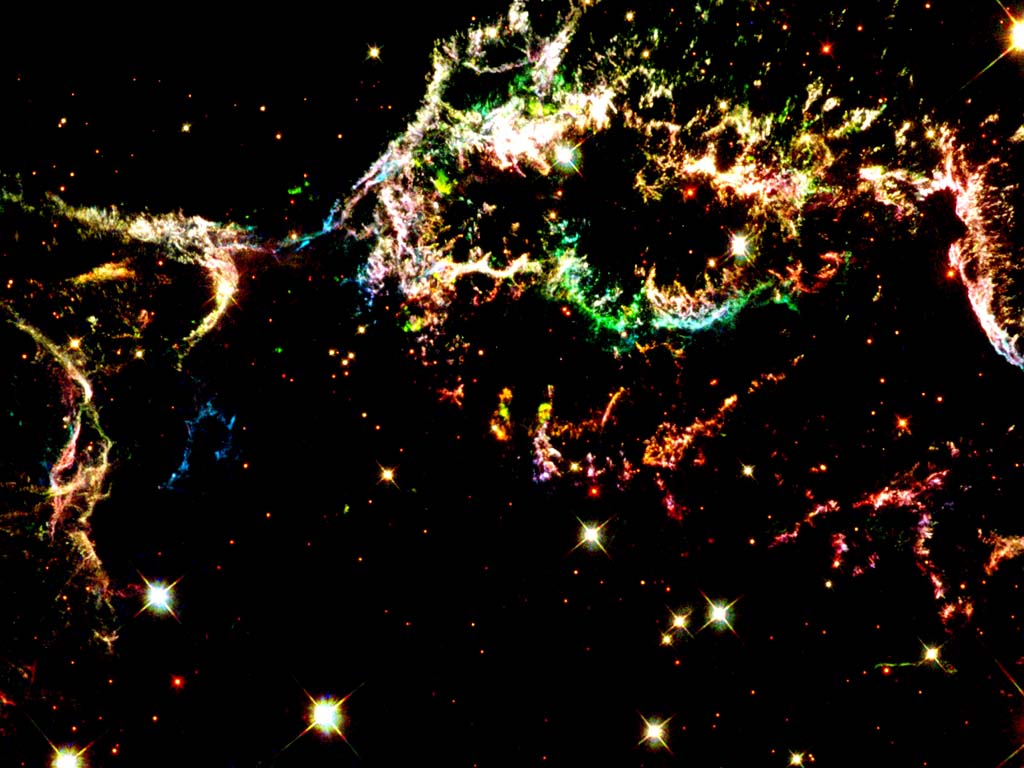
New York (SPX) Aug 31, 2006 Stars may lead fascinating lives, but sometimes it's in death that they really shine. Some stars finish up as black holes but, a moment before the end, they explode, sending material in all directions and shining with a light that can be seen throughout the universe. This end only comes to the heavies of the neighborhood, those that weigh 30 times as much as our sun or more. When it happens, their dazzling light can be seen at much greater distances than before the event. Thus, early observers of the heavens saw bright points of light appear in the sky where none had existed the night before, and they dubbed them "supernova" or "new stars." Until now, scientists had only been able to spot supernovae several days after stars in the process of exploding had begun to brighten. But the scientists who investigate this phenomenon needed to be able to observe what happens to these stars in real time. That's precisely what NASA scientists have managed to do for the first time, and their achievement has confirmed theoretical research carried out by Prof. Eli Waxman of the Weizmann Institute's Department of Condensed Matter Physics. Aided by NASA's advanced research satellite, Swift, the scientists succeeded in detecting a supernova just 160 seconds after the event began. Seeing the supernova so early allowed the scientists to observe, in addition to the material being expelled in all directions, jets of gamma rays and x rays shooting out from the vicinity of the explosion. This confirmed the theory that supernovas are the source of gamma ray bursts that have been measured in the past. They also found that the star was composed mainly of oxygen and carbon, signs that the star was, indeed, very heavy. For the first time, scientists were able to identify shock waves that give rise to the gamma and x-ray radiation emanating from the center of the star and moving toward the surface. These findings have bolstered the theoretical model of such supernova explosions proposed by Waxman several years ago. Prof. Eli Waxman's research is supported by the Rosa and Emilio Segre Fund. Related Links American Committee for the Weizmann Institute of Science  Astronomers Use Supercomputers To Study Atoms Linked To Black Holes
 Columbus OH (SPX) Aug 25, 2006
Super-hot atoms in space hold the key to an astronomical mystery, and an Ohio State University astronomer is leading an effort to study those atoms here on Earth. |
|
|

| The content herein, unless otherwise known to be public domain, are Copyright 1995-2006 - SpaceDaily.AFP and UPI Wire Stories are copyright Agence France-Presse and United Press International. ESA PortalReports are copyright European Space Agency. All NASA sourced material is public domain. Additionalcopyrights may apply in whole or part to other bona fide parties. Advertising does not imply endorsement,agreement or approval of any opinions, statements or information provided by SpaceDaily on any Web page published or hosted by SpaceDaily. Privacy Statement |