|
 |
 |
 |
 |
 |
 |
 |
 |
 |

| . |  |
. |
Tiny Meteorite Grains Help Settle An Astronomical Debate
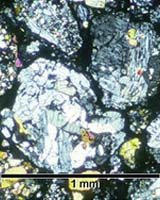
Washington DC (SPX) Sep 03, 2004 "These tiny relics, a millionth of a meter small, could point us to the first steps of dust formation in both old and young stars," stated Dr. Larry Nittler of the Carnegie Institution's Department of Terrestrial Magnetism. Nittler is co-author of a study published in the September 3, 2004, issue of Science, about the origin of two presolar grains from the Tieschitz meteorite and the implications they have for resolving observational and theoretical challenges of dusty outflows surrounding asymptotic giant branch (AGB) stars - one of the last evolutionary stages of low-mass stars like the Sun. Both theoreticians and observational astronomers have long grappled with the issue of whether aluminum oxide - which in its crystalline form is the second hardest natural material- is the first solid to condense as hot, gaseous winds from oxygen-rich AGB stars expand and cool. "Because AGB stars are the most significant source of dust in the Milky Way galaxy, determining how and in what form this dust condenses is important to understanding how the chemical elements get cycled between stars and interstellar space," said Nittler. "Also, the first solids in cooling disks around new stars form by analogous processes to those occurring around AGB stars, so these grains give us a glimpse into the earliest stages of our own solar system formation." Observational astronomers have obtained telltale infrared spectra from dusty AGB stars that have indicated the possible presence of two forms of aluminum oxide - the crystalline form and an amorphous, or non crystalline form. However, the data have not been precise enough to tell if both forms are really present. "This study is really the first definitive analysis that indicates that both forms are indeed produced in AGB stars," said Professor Tom Bernatowicz of Washington University in St. Louis. The authors analyzed the ratios of oxygen and magnesium isotopes in the grains in addition to their microstructures and chemical compositions. Different isotopes of the same element are affected to differing degrees by the nuclear reactions that power stars. The isotopic analysis indicated that the grains originated in AGB stars and did not undergo further processing as they made their way through time ultimately to become part of the dusty cloud from which the solar system formed 4.6 billion years ago. However, their structures are very different, as are their chemical compositions. One is a single-crystal of the most common form of aluminum oxide--called corundum--while the other does not exhibit a crystalline structure. The corundum grain has small, but measurable, amounts of titanium impurities as well. The evidence clarifies observations suggesting that the two different forms of aluminum oxide are made in AGB outflows. It is also vital to the refinement of condensation modeling and the understanding of how dust originates in the universe. Related Links Carnegie Institution's Department of Terrestrial Magnetism Washington University in St. Louis SpaceDaily Search SpaceDaily Subscribe To SpaceDaily Express  Choices In The Quantum Universe
 Moffett Field CA (SPX) Sep 01, 2004
"It was a blast," said Persis Drell, director of research at the Stanford Linear Accelerator Center (SLAC), "the most fun committee I've ever been on." |
|
|

| The content herein, unless otherwise known to be public domain, are Copyright 1995-2006 - SpaceDaily.AFP and UPI Wire Stories are copyright Agence France-Presse and United Press International. ESA PortalReports are copyright European Space Agency. All NASA sourced material is public domain. Additionalcopyrights may apply in whole or part to other bona fide parties. Advertising does not imply endorsement,agreement or approval of any opinions, statements or information provided by SpaceDaily on any Web page published or hosted by SpaceDaily. Privacy Statement |