
Subscribe free to our newsletters via your
. Military Space News .


FARM NEWS
Tiny plants could cut costs, shrink environmental footprint
by Brian Wallheimer
West Lafayette, IN (SPX) May 16, 2012


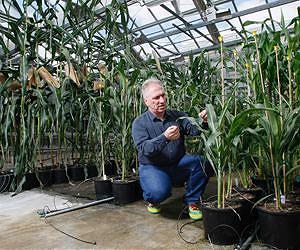
Burkhard Schulz found that a fungicide used to treat brown spots on golf courses inhibits a plant's ability to produce steroids, resulting in smaller, feminized corn plants. Here, Schulz examines sorghum treated with the fungicide while untreated corn in the background rises far above the dwarfed grain plants. (Purdue Agricultural Communication photo/Tom Campbell).

Tall, waving corn fields that line Midwestern roads may one day be replaced by dwarfed versions that require less water, fertilizer and other inputs, thanks to a fungicide commonly used on golf courses.

Burkhard Schulz, a Purdue University assistant professor of plant biochemical and molecular genetics, had earlier found that knocking out the steroid function in corn plants would create tiny versions that only had female sex characteristics. But brassinazole, the chemical used to inhibit the plant steroid biosynthesis, was prohibitively expensive.

One gram of brassinazole could cost as much as $25,000, so Schulz started looking into other options. He found that propiconazole, used to treat fungal dollar spot disease on golf courses, is more potent and costs about 10 cents for the same amount.

"Any research where you needed to treat large plants for long periods of time would have been impossible," Schulz said. "Those tests before would have cost us millions of dollars. Now, they cost us $25. This will open up research in crops that was not possible before."

Schulz's earlier work showed that inhibiting steroids in maize produced short, feminized versions of the plants that developed more kernels where pollen would normally grow. Those findings came from adding chemicals and altering genes to disrupt steroid production. His new finding shows that a widely available fungicide can do the same thing.

"We can change the architecture of a plant the same way that has been done through breeding," said Schulz, whose findings were published in the journal PLoS One. "We can treat plants with this substance throughout the plant's life and it will never be able to produce steroids."

That could be significant for seed producers, who must mechanically remove tassels, the male portion of the plants, so that they do not pollinate themselves. The process is labor-intensive.

Shorter plants that produce the same amount of grain could also reduce agriculture's environmental footprint. Those plants would need much less water, fertilizer and pesticides. Schulz said wider application on golf courses could also slow grass growth, minimizing the amount of mowing that would have to be done.

"This could significantly reduce costs for golf courses," he said. "If you could eliminate one cutting per week even, it would be considerable because there are so many golf courses."

Schulz said propiconazole is recognized as a safe chemical for humans.

"They treat golf courses with it. People are around it every day," he said.

Schulz plans to test other grain crops to see if propiconazole would retard steroid production in those plants, or whether the effect is specific to maize. He is also determining which genes the fungicide affects. The research project is a collaboration between Schulz's Purdue team and researchers at Seoul National University in South Korea.

.


Related Links
Agriculture at Purdue
Farming Today - Suppliers and Technology


Comment on this article via your Facebook, Yahoo, AOL, Hotmail login.

Share this article via these popular social media networks
del.icio.usdel.icio.us DiggDigg RedditReddit GoogleGoogle


FARM NEWS
Agricultural bacteria: Blowing in the wind
Washington DC (SPX) May 15, 2012
It was all too evident during the Dust Bowl what a disastrous impact wind can have on dry, unprotected topsoil. Now a new study has uncovered a less obvious, but still troubling, effect of wind: Not only can it carry away soil particles, but also the beneficial microbes that help build soil, detoxify contaminants, and recycle nutrients. Using a powerful DNA sequencing technique, called pyr ... read more


FARM NEWS
Russia Does Not Rule Out Preemptive Missile Defense Strike

Pentagon to unveil funding for Israel

NATO chief determined to move ahead with missile shield

House panel OKs $1B for Israel's missiles

FARM NEWS
Lockheed Martin's New Standalone Launching System Significantly Reduces Weapons Integration Costs

The top issues at the NATO summit

Raytheon Completes First Flight Test of Improved SM-3

Russia Pulls Out of Indonesian Rocket System Tender

FARM NEWS
3D MAW (FWD) explores the use of unmanned helicopters

GE Aviation to Participate in Demo on AAI's Shadow UAS

Autonomous Vehicle Developed for Surveying Assault-Zone Runways

Spy drone crash kills engineer in S. Korea: police

FARM NEWS
Second AEHF Military Communications Satellite Launched

Fourth Boeing-built WGS Satellite Accepted by USAF

Raytheon to Continue Supporting Coalition Forces' Information-Sharing Computer Network

Northrop Grumman Wins Contract for USAF Command and Control Modernization Program

FARM NEWS
BBN Technologies awarded intelligence funding for metaphor research

"Dip Chip" Technology Tests Toxicity On-the-Go

US restricts flights of F-22 jets over safety worries

Two Lockheed Martin F-35Bs Ferried To Eglin, Marking 25th DOD Delivery

FARM NEWS
Smiles and frowns over defense deals

Viktor Bout appeals the verdict

German court orders Canadian-German arms dealer freed

Congress panel backs higher arms buys

FARM NEWS
NATO: The world's biggest defence alliance

Outside View: The Chicago NATO summit

G8 to tackle Syria, NKorea, Iran, Afghanistan, Myanmar

Hollande vows new strategy for France and Europe

FARM NEWS
New technique uses electrons to map nanoparticle atomic structures

Light touch keeps a grip on delicate nanoparticles

Next-Generation Nanoelectronics: A Decade of Progress, Coming Advances

Nanotech gets boost from nanowire decorations


The content herein, unless otherwise known to be public domain, are Copyright 1995-2014 - Space Media Network. AFP, UPI and IANS news wire stories are copyright Agence France-Presse, United Press International and Indo-Asia News Service. ESA Portal Reports are copyright European Space Agency. All NASA sourced material is public domain. Additional copyrights may apply in whole or part to other bona fide parties. Advertising does not imply endorsement,agreement or approval of any opinions, statements or information provided by Space Media Network on any Web page published or hosted by Space Media Network. Privacy Statement