|
 |
 |
 |
 |
 |
 |
 |

| . |  |
. |

|
|
. |

 by Staff Writers Pasadena CA (JPL) Dec 23, 2011
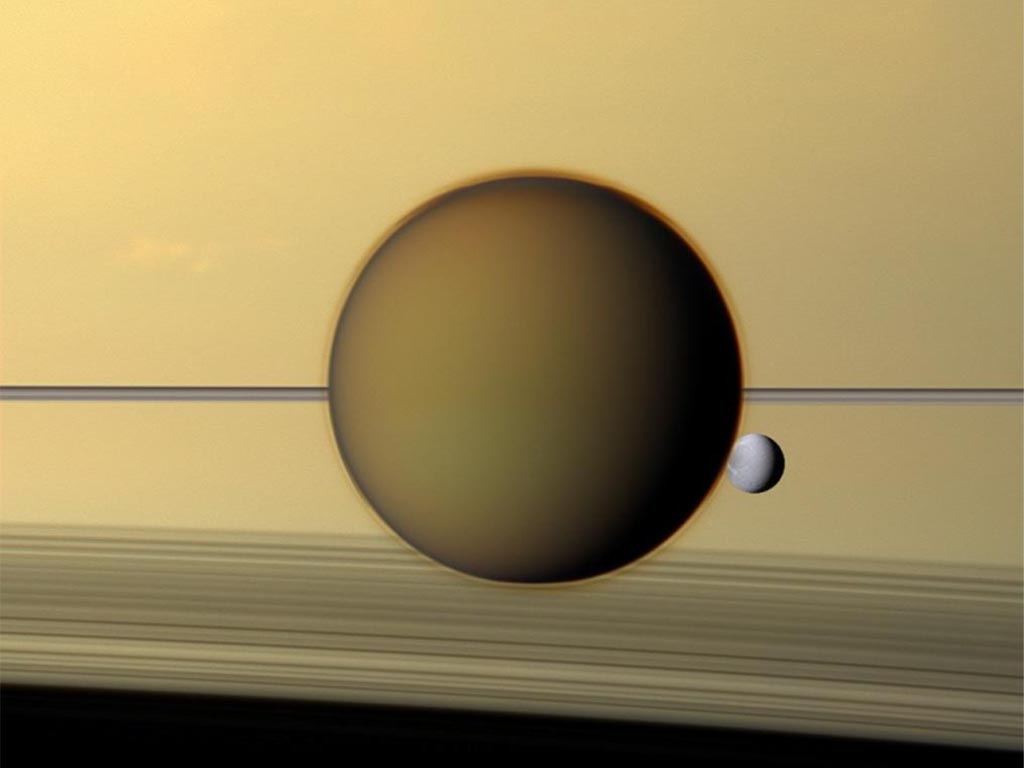
Saturn's third-largest moon Dione can be seen through the haze of its largest moon, Titan, in this view of the two posing before the planet and its rings from NASA's Cassini spacecraft. The north polar hood can be seen on Titan appearing as a detached layer at the top of the moon here. See PIA08137 and PIA09739 to learn more about Titan's atmosphere and the north polar hood. See PIA10560 and PIA07638 to learn more about and see a closer view of the wisps on Dione's trailing hemisphere, which appear as bright streaks here. This view looks toward the anti-Saturn side of Titan (3200 miles, 5150 kilometers across) and Dione (698 miles, 1123 kilometers across). North is up on the moons. This view looks toward the northern, sunlit side of the rings from just above the ring plane. Images taken using red, green and blue spectral filters were combined to create this natural color view. The images were obtained with the Cassini spacecraft narrow-angle camera on May 21, 2011 at a distance of approximately 1.4 million miles (2.3 million kilometers) from Titan 2 million miles (3.2 million kilometers) from Dione. Image scale is 9 miles (14 kilometers) per pixel on Titan and 12 miles (19 kilometers) on Dione. Cassini scientists regularly make observations such as this pictured here to study the ever-changing orbits of the planet's moons. But even in these routine images, the Saturnian system shines. A few of Saturn's stark, airless, icy moons appear to dangle next to the orange orb of Titan, the only moon in the solar system with a substantial atmosphere. Titan's atmosphere is of great interest because of its similarities to the atmosphere believed to exist long ago on the early Earth. While it may be wintry in Earth's northern hemisphere, it is currently northern spring in the Saturnian system and it will remain so for several Earth years. Current plans to extend the Cassini mission through 2017 will supply a continued bounty of scientifically rewarding and majestic views of Saturn and its moons and rings, as spectators are treated to the passage of northern spring and the arrival of summer in May 2017. "As another year traveling this magnificent sector of our solar system draws to a close, all of us on Cassini wish all of you a very happy and peaceful holiday season, " said Carolyn Porco, Cassini imaging team lead at the Space Science Institute, Boulder, Colo.
Cassini at JPL Cassini images Explore The Ring World of Saturn and her moons Jupiter and its Moons The million outer planets of a star called Sol News Flash at Mercury
|
. |
|
| The content herein, unless otherwise known to be public domain, are Copyright 1995-2012 - Space Media Network. AFP and UPI Wire Stories are copyright Agence France-Presse and United Press International. ESA Portal Reports are copyright European Space Agency. All NASA sourced material is public domain. Additional copyrights may apply in whole or part to other bona fide parties. Advertising does not imply endorsement,agreement or approval of any opinions, statements or information provided by Space Media Network on any Web page published or hosted by Space Media Network. Privacy Statement |

 del.icio.us
 Digg
Digg Reddit
 Google