Subscribe free to our newsletters via your
. Military Space News .


SATURN DAILY
Titan's Methane: Going, Going, Soon to Be Gone?
by Staff Writers
Pasadena CA (JPL) Apr 17, 2013


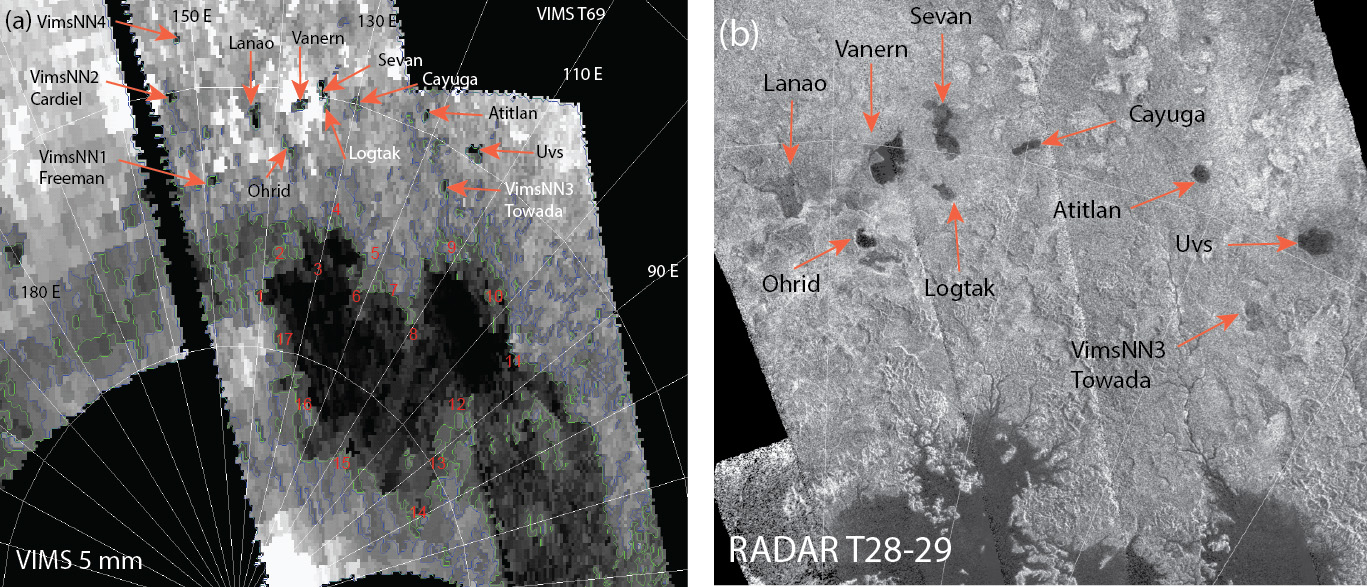
These images from NASA's Cassini spacecraft show one of the large seas and a bounty of smaller lakes on Saturn's moon Titan. Scientists saw these small lakes in data obtained by both Cassini's visual and infrared mapping spectrometer (left) and radar instrument (right). Image credit: NASA/JPL-Caltech/University of Arizona. For a larger version of this image please go here.

By tracking a part of the surface of Saturn's moon Titan over several years, NASA's Cassini mission has found a remarkable longevity to the hydrocarbon lakes on the moon's surface.

A team led by Christophe Sotin of NASA's Jet Propulsion Laboratory in Pasadena, Calif., fed these results into a model that suggests the supply of the hydrocarbon methane at Titan could be coming to an end soon (on geological timescales). The study of the lakes also led scientists to spot a few new ones in images from Cassini's visual and infrared mapping spectrometer data in June 2010.

Titan is the only other place in the solar system besides Earth that has stable liquid on its surface. Scientists think methane is at the heart of a cycle at Titan that is somewhat similar to the role of water in Earth's hydrological cycle - causing rain, carving channels and evaporating from lakes.

However, the fact that the lakes seem remarkably consistent in size and shape over several years of data from Cassini's visual and infrared mapping spectrometer suggests that the lakes evaporate very slowly. Methane tends to evaporate quickly, so scientists think the lakes must be dominated by methane's sister hydrocarbon ethane, which evaporates more slowly.

The lakes are also not getting filled quickly, and scientists haven't seen more than the occasional outburst of hydrocarbon rain at the moon over the mission's eight-plus years in the Saturn system.

This indicates that on Titan, the methane that is constantly being lost by breaking down to form ethane and other heavier molecules is not being replaced by fresh methane from the interior.

The team suggests that the current load of methane at Titan may have come from some kind of gigantic outburst from the interior eons ago possibly after a huge impact. They think Titan's methane could run out in tens of millions of years.

.


Related Links
Saturn at JPL
Explore The Ring World of Saturn and her moons
Jupiter and its Moons
The million outer planets of a star called Sol
News Flash at Mercury


Comment on this article via your Facebook, Yahoo, AOL, Hotmail login.

Share this article via these popular social media networks
del.icio.usdel.icio.us DiggDigg RedditReddit GoogleGoogle


SATURN DAILY
Ice Cloud Heralds Fall at Titan's South Pole
Greenbelt MD (SPX) Apr 15, 2013
An ice cloud taking shape over Titan's south pole is the latest sign that the change of seasons is setting off a cascade of radical changes in the atmosphere of Saturn's largest moon. Made from an unknown ice, this type of cloud has long hung over Titan's north pole, where it is now fading, according to observations made by the Composite Infrared Spectrometer (CIRS) on NASA's Cassini spacecraft. ... read more


SATURN DAILY
Pentagon requests more funding for Israel's 'Iron Dome'

Lockheed Martin PAC-3 Missile Intercepts and Destroys Tactical Ballistic Missile in New Test

Japan's missile defence plan: some facts

Poland guarantees funds for missile shield

SATURN DAILY
Lockheed Martin's Nemesis Missile Scores 3-For-3 in Flight Tests

Guam heightens alert level after N. Korea threats

US warns N. Korea ahead of expected missile launch

Raytheon demonstrates new Joint Standoff Weapon Extended Range integrated fuel system

SATURN DAILY
Pentagon calls off new medal for drone, cyber warriors

Red Cross chief criticises drone use outside battlefields

Saudis 'turn to South Africa for UAVs'

AeroVironment Receives Order US Army for RQ-11B Raven UAVs And Gimbaled Payloads

SATURN DAILY
Lockheed Martin Awarded Contract to Modernize U.S. Joint Theater Air Operations System

Boeing Delivers FAB-T Test Units to US Air Force

Fourth Lockheed Martin MUOS Satellite Entering System Test as Communication Module and Multi-Beam Antenna Installed

Advancing secure communications: A better single-photon emitter for quantum cryptography

SATURN DAILY
Smaller Pixels, Smaller Thermal Cameras for Warfighters

Raytheon awarded DTRA border security contract

Updated Laser Rangefinder/Designator From Northrop Grumman, DRS Technologies Completes Flight Testing

Lockheed Martin to Provide US Army with Simulation-Based Command and Battle Staff Training System

SATURN DAILY
SIPRI: Latin America military spending up

US soldier jailed for trying to sell secrets to Russians

Obama's budget avoids big cuts to US military spending

Lagardere books 1.8 bn euros from EADS share sale

SATURN DAILY
NATO head lauds Japan cooperation pledge

Lithuania, Serbia PMs hail breakthrough in strained relations

Hollande to visit China: Beijing

China faces threats but will defend itself: government

SATURN DAILY
New device could cut costs on household products, pharmaceuticals

Nanotechnology imaging breakthrough

Surface diffusion plays a key role in defining the shapes of catalytic nanoparticles

Imaging methodology reveals nano details not seen before


The content herein, unless otherwise known to be public domain, are Copyright 1995-2014 - Space Media Network. AFP, UPI and IANS news wire stories are copyright Agence France-Presse, United Press International and Indo-Asia News Service. ESA Portal Reports are copyright European Space Agency. All NASA sourced material is public domain. Additional copyrights may apply in whole or part to other bona fide parties. Advertising does not imply endorsement,agreement or approval of any opinions, statements or information provided by Space Media Network on any Web page published or hosted by Space Media Network. Privacy Statement