|
 |
 |
 |
 |
 |
 |
 |
 |
 |

| . |  |
. |
Titan's Methane Mystery May Be Solved
Nantes, France (SPX) March 1, 2006 An international team of planetary scientists said they may have solved the mystery of why the atmosphere of Saturn's giant moon, Titan, is rich in methane. Scientists at the University of Nantes and the University of Arizona in Tucson analyzed results from ESA's Huygens probe, which landed on Titan on Jan. 14, 2005, and from remote-sensing instruments on NASA's Cassini spacecraft. They found three major episodes of outgassing during the moon's history that pumped methane into the mostly nitrogen atmosphere. The presence of atmospheric methane on Titan has been one of the major enigmas the Cassini-Huygens mission to the Saturnian system has been trying to resolve. Methane, which on Titan plays a role similar to water on Earth, is locked in methane-rich water ice that forms a crust above an ocean of liquid water mixed with ammonia. When the Huygens probe warmed Titan's damp surface where it landed, its instruments inhaled whiffs of methane. The heat of the probe caused methane trapped in pores just below the surface to evaporate, just as subsurface water would evaporate on Earth if something heated the sand of a dry streambed. Scientists have long known that Titan's atmosphere contains methane, ethane, acetylene and many other hydrocarbon compounds. The problem with methane is sunlight destroys it after tens of millions of years, so something has replenished the gas in Titan's thick air during its 4.5 billion-year history - leading some scientists to speculate there could be organic processes at work on the moon's surface. Based on the Cassini-Huygens data, however, the team found a release of methane happened after Titan formed its dense rock core and water mantle beneath an ice crust. The first release was aided by ammonia acting as an anti-freeze, heat leftover from formation, and heat from radioactive elements, explained Arizona's Jonathan Lunine, an interdisciplinary scientist for the Huygens probe. Much of the methane in this first release might have been reabsorbed into Titan's interior, Lunine continued, but whatever was left in the atmosphere had to have been photochemically destroyed during the first billion years. The second methane-release episode occurred around 2 billion years ago, the team reports in the March 2 issue of the journal Nature. "The core, made of rock, continued to heat up because it contains natural radioactive elements, like uranium, potassium and thorium," Lunine said. "On Earth, these elements are concentrated in the crust, but on Titan, they'd be deep down in the rock. So the core gets hotter and hotter, until finally it's soft enough for convection to start." Convection is the mechanical turnover of material to remove heat. The second event injected a burst of convection heat into Titan's overlying mantle, causing the ice crust to thin and methane to pour through the ice to the surface. The latest methane-release episode began around 500 million years ago, again the result of convection in Titan's solid ice crust. The cause for each outgassing episode differed, but the results were the same: "There's an injection of methane into the surface and atmosphere of Titan," Lunine said. "We are now in an era where there's enough outgassing to add methane to the atmosphere, but not enough for widespread seas of methane." The scientists are confident the latest outgassing episode will be Titan's last. "There'll be no further such events until billions of years in the future, when the Sun goes red giant and cooks Titan," Lunine explained. "Methane outgassing will cease within the next few hundred million years. Then photochemistry will destroy the surface methane and Titan will indeed dry up. The atmosphere will clear of haze, and Titan will look very different." Lunine's co-authors were Gabriel Tobie and Christophe Sotin of the University of Nantes. Lunine currently is on sabbatical at the Italian National Astrophysics Institute in Rome. Related Links ESA Cassini-Huygens  Saturn Moons In Ghostly Specter
 Pasadena CA (SPX) March 1, 2006
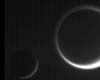
Ghostly details make this dark scene more than just a beautiful grouping of two Saturn moons, with Tethys on the left and Titan on the right. |
|
|

| The content herein, unless otherwise known to be public domain, are Copyright 1995-2006 - SpaceDaily.AFP and UPI Wire Stories are copyright Agence France-Presse and United Press International. ESA PortalReports are copyright European Space Agency. All NASA sourced material is public domain. Additionalcopyrights may apply in whole or part to other bona fide parties. Advertising does not imply endorsement,agreement or approval of any opinions, statements or information provided by SpaceDaily on any Web page published or hosted by SpaceDaily. Privacy Statement |