
 |
 |
 |
 |
 |
 |
 |
 |
 |
 |

| . |  |
. |
Top Five Breakthroughs From Hubble's Workhorse Camera
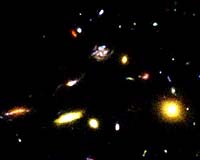
Pasadena CA (SPX) May 05, 2009 Deepest photograph of the universe. Hubble's famous "Deep Field" picture, taken by the Wide Field and Planetary Camera 2, left the world with its mouth agape when it was first revealed in 1996. In just a small patch of sky, more than 1,000 galaxies located billions of light-years away could be seen floating in space like sea creatures at the bottom of an endless ocean. Our world and our galaxy suddenly seemed very small. Observations of comet collision with Jupiter. The Wide Field and Planetary Camera 2 gave the world a rare, stunning view of Comet Shoemaker-Levy 9 plunging into the gas giant Jupiter in 1994. The images revealed the event in great detail, including ripples expanding outward from the impact. The birth and death of stars. The Wide Field and Planetary Camera 2 brought the cosmos down to Earth with its exquisite pictures of stars in all stages of development. Its famed picture of the "Pillars of Creation" and other images of colorful dying stars offered the first, glorious views of a star's life. The camera also took the first pictures of the dusty disks around stars where planets are born, demonstrating that planet-forming environments are common in the universe. The age and rate of expansion of our universe. Our universe formed from a colossal explosion known as the Big Bang, and has been stretching apart ever since. Hubble's Wide Field and Planetary Camera 2, by observing stars that vary periodically in brightness, was able to calculate the pace of this expansion to an unprecedented degree of error of 10 percent. The camera also played a leading role in discovering that the expansion of the universe is accelerating, driven by a mysterious force called "dark energy." Together, these findings led to the calculation that our universe is approximately 13.7 billion years old. Most galaxies harbor huge black holes. Before Hubble, astronomers suspected, but had no proof, that supermassive black holes lurk deep in the bellies of galaxies. The Wide Field and Planetary Camera 2, together with spectroscopy data from Hubble, showed that most galaxies in the universe do indeed harbor monstrous black holes up to billions of times the mass of our sun. Share This Article With Planet Earth
Related Links Hubble Space Telescope News and Technology at Skynightly.com
 IMAX-3D Camera To Film Hubble Servicing Mission
 Washington DC (SPX) May 05, 2009
NASA, the IMAX Corporation and Warner Bros. Pictures have announced that IMAX 3-D cameras will return to space to document one of NASA's most complex space shuttle operations: the final servicing mission to the Hubble Space Telescope. |
|
|

| The content herein, unless otherwise known to be public domain, are Copyright 1995-2007 - SpaceDaily.AFP and UPI Wire Stories are copyright Agence France-Presse and United Press International. ESA Portal Reports are copyright European Space Agency. All NASA sourced material is public domain. Additional copyrights may apply in whole or part to other bona fide parties. Advertising does not imply endorsement,agreement or approval of any opinions, statements or information provided by SpaceDaily on any Web page published or hosted by SpaceDaily. Privacy Statement |
 del.icio.us
 Digg
Digg Reddit
 YahooMyWeb
 Google
 Facebook