
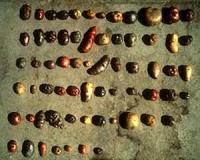
Mashed, smashed and fried, Americans love potatoes, but only a few varieties are grown in much of North American agriculture. In South America, where potatoes originated, more than 5,000 varieties continue to exist. A Penn State geographer is gathering all the information he can about the agrobiodiversity of these uniquely adapted tubers with an eye toward sustainability of this fourth largest food crop worldwide.
"In the U.S. we rely primarily on 10 to 12 types of potatoes total," said Karl Zimmerer, department head and professor of geography. "In fact, mostly we use only 5 to 8 varieties. In South America, by contrast, there are 74 different types of potatoes in a single field. The fields, tubers and landscapes are visually stunning."
Zimmerer has studied high-agrobiodiversity land use for over 20 years, but until recently, those studies have been on the ground. He first looked at diversity within individual potato fields and then scaled up to individual communities and landscapes. People in a community have expert knowledge of 150 to 180 varieties of potato, he said.
"People in Peru, for example, love to eat potatoes and think that theirs are vastly superior to what we have in flavor, texture, starchiness and color," said Zimmerer. "They want to hang on to their high-agrobiodiversity potatoes and we want them to hang due to nutritional, ecological and other conservation advantages."
Scaling up even more, Zimmerer looked at potato fields on the landscape level — typically groups of 5 to 15 communities — and regions that contain upward of 30 or 40 communities. Remote sensing approaches made this easier, but still only supplied part of the answers to identifying agrobiodiversity hotspots — biologically rich but environmentally and socioeconomically threatened areas — and creating ways to protect these areas and conserve these crops.
Because the major potato growing area encompasses large parts of northern South America, Zimmerer needed a novel approach, which he presented Feb. 15 at the annual meeting of the American Association for the Advancement of Science in Chicago, where he organized a symposium on new agrobiodiversity discoveries needed for sustainability.
"There are 4,000 to 5,000 different varieties of potato in Chile, Colombia, Northern Argentina, Peru, Bolivia, Ecuador and Venezuela," said Zimmerer. "Up until now, the areas where varieties grow were just designated as large, undifferentiated shapes on the map. In order to support agrobiodiversity, we have to have an idea of large-area agrobiodiversity concentrations, so we have to look from the top down."
With this approach, identifying and analyzing region-scale areas of concentrated agrobiodiversity are important, as are the global institutions such as the International Potato Center in Peru. But perhaps the most important part of the top down study is the knowledge held by expert potato taxonomists who have long histories of geographically extensive work.
"One example is Alberto Salas who has 60 years of experience and has vast geographic and agrobiodiversity knowledge," said Zimmerer. "He is a Peruvian who has worked from Chile to Venezuela and has an extraordinary knowledge of major areas where diverse potato types are located."
While many experts are local to potato growing areas, other experts come from Europe and North America. To assemble an expert database of information about locations of potato hotspots, Zimmerer uses a two-pronged approach. For those comfortable with computers, he asks them to delineate on Google Earth maps the regions of concentrated agrobiodiversity. For those uncomfortable with computers, the same tasks can be performed using paper maps.
Once the regional hotspot locations are on the electronic map, other information such as elevation, socioeconomic characteristics and slope becomes available. Information from the various experts can also be compared.
With so many varieties, it is difficult for even the local farmers to identify and keep track of the potatoes growing in their and their neighbor's fields. Zimmerer's approach may eventually be used for visualizations that help enable the local crowdsourcing of this agrobiodiversity.
"The local farmers generally identify their potatoes on their culinary properties and uses — floury, soup making or freeze drying," said Zimmerer. "Interestingly, the culinary uses correspond to the elevations where the potatoes grow — soup potatoes have the lowest elevation, floury potatoes in mid elevation and freezing potatoes are the highest."
This type of information from the knowledge systems of farmers — often women — coupled with top down image analysis, visualization and geographic information systems can supply important information for sustainability and conservation. Combining the top-down and bottom-up information provides novel knowledge and new strategies for sustainable use of the extraordinarily high levels of biodiversity within the Andean potatoes.
Zimmerer is already applying this approach to other crops such as corn, which also includes many unique types with geographic dynamics being a key to adaptation and sustainability.
