
Subscribe free to our newsletters via your
. Military Space News .


FARM NEWS
Trees and shrubs invading critical grasslands, diminish cattle production
by Staff Writers
Tempe AZ (SPX) Aug 19, 2014


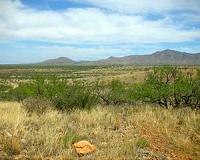
Grasslands are being transformed at an alarming rate as woody plants, such as trees and shrubs, take over. This is leading to a loss of critical habitat and causing a drastic change in the ability of ecosystems to produce food. This is one example near the Santa Rita mountains in Arizona. Image courtesy Osvaldo Sala.

Half of the Earth's land mass is made up of rangelands, which include grasslands and savannas, yet they are being transformed at an alarming rate. Woody plants, such as trees and shrubs, are moving in and taking over, leading to a loss of critical habitat and causing a drastic change in the ability of ecosystems to produce food - specifically meat.

Researchers with Arizona State University's School of Life Sciences led an investigation that quantified this loss in both the United States and Argentina. The study's results are published in the online issue of the scientific journal Proceedings of the National Academy of Sciences (PNAS).

"While the phenomenon of woody plant invasion has been occurring for decades, for the first time, we have quantified the losses in ecosystem services," said Osvaldo Sala, Julie A. Wrigley Chair and Foundation Professor with ASU's School of Life Sciences and School of Sustainability.

"We found that an increase in tree and shrub cover of one percent leads to a two percent loss in livestock production." And, woody-plant cover in North America increases at a rate between 0.5 and two percent per year.

In recent years, the U.S. government shelled out millions of dollars in an effort to stop the advance of trees and shrubs. The U.S. Natural Resources Conservation Service spent $127 million from 2005-2009 on herbicides and brush management, without a clear understanding of its economic benefit.

The research team used census data from the U.S. and Argentina to find out how much livestock exists within the majority of the countries' rangelands. In both countries, the team studied swaths of rangeland roughly the size of Texas - approximately 160 million acres each.

These lands support roughly 40 million heads of cattle. Researchers also used remote sensors to calculate the production of grasses and shrubs. And, to account for the effects of different socioeconomic factors, researchers quantified the impact of tree cover on livestock production in two areas of the world that have similar environments, but different level of economic development.

Surprisingly, the presence of trees explained a larger fraction of livestock production in Argentina than in the US.

"What's happening in Argentina seems to be a much narrower utilization of rangelands," added Sala. "The land there is mostly privately-owned and people who have ranches are producing predominantly meat to make a profit. But in the U.S., many people who own ranches don't actually raise cattle. They are using the land for many other different purposes."

While ranchers clearly depend on grasslands to support healthy livestock, ecosystems also provide a range of other services to humans. Stakeholders such as conservationists, farmers, builders, government entities and private landowners, depend on the land for a variety of reasons and each has different values and land use needs.

Why are trees and shrubs taking over grasslands? There are several hypotheses as to why woody plant encroachment is happening. Fire reduction, grazing intensity, climate change, and increased carbon dioxide in the atmosphere are some widely held beliefs as to the cause. However, Sala's study is focused not on the cause, but rather on the cost of this change to people.

"For each piece of land, there are different people who have an interest in that land and they all have different values. And, they are all okay," said Sala.

"However, in order to negotiate how to use the land and to meet the needs of these different stakeholders, we need concrete information. We now know how much increase in tree cover is affecting the cattle ranchers."

Sala and his colleagues hope that the information found in their study will be used to inform discussions as policy makers and other stakeholders negotiate changes in land use. Researchers who took part in the study include Sala and Billie Turner II with ASU, Jose Anadon with City University of New York, and Elena Bennett with McGill University. National Academies Keck Futures Initiative and the U.S. National Science Foundation funded the study.

.


Related Links
Arizona State University
Farming Today - Suppliers and Technology


Comment on this article via your Facebook, Yahoo, AOL, Hotmail login.

Share this article via these popular social media networks
del.icio.usdel.icio.us DiggDigg RedditReddit GoogleGoogle


FARM NEWS
Make your mobile device live up to its true potential - as a data collection tool
St. Louis MO (SPX) Aug 19, 2014
Leaf measurements are often critical in plant physiological and ecological studies, but traditional methods have been time consuming and sometimes destructive to plant samples. Researchers at the University of California, Davis, have developed Easy Leaf Area-a free software written in an open-source programming language-to allow users to accurately measure leaf area from digital images in second ... read more


FARM NEWS
US Congress approves funding for Israel's Iron Dome

MEADS International touts its air defense system capabilities

Space surveillance satellites being sent into orbit

Patriot getting enhanced radar capabilities

FARM NEWS
U.S. Navy, Italy receiving more AARGM missiles

Nearly all Gaza rockets self-made: Israeli army

Russia has violated arms treaty by testing cruise missile: US

MD 530G attack helicopters fires Talon rockets

FARM NEWS
US names New York test site for small drones

Northrop completes UAV fuselage for NATO program

Brazil's Flight Tech exporting UAV

Drones thrill Martha Stewart... and US prison convicts

FARM NEWS
ADS will bid for USAF order for commercial satellite bandwidth

RRC supports Navy's Satellite Communications Facility in Virginia

Communications system used in Afghanistan gets Northrop support

Fourth MUOS Communication Satellite Clears Launch-Simulation Test

FARM NEWS
Greek Army's German-made Leopard tanks getting ammunition

Army orders equipment from TeleCommunication Systems Inc.

Raytheon partners with university of technology research

USAF cargo loaders getting support from DRS

FARM NEWS
German coalition bickers over arms exports

Putin vows to boost arms sales to Egypt's Sisi

Denel to buy BAE Systems company in South Africa

"Red tape" should not mar India-US defense cooperation: Hagel

FARM NEWS
Enforced silence at China's Cultural Revolution museum

Russia 'guaranteed' no soldiers in Ukraine convoy: US

Tensions soar as Ukraine says destroys Russian armour

Pope pushes dialogue with Asian nations like China

FARM NEWS
Eco-friendly 'pre-fab nanoparticles' could revolutionize nano manufacturing

Self-assembly of gold nanoparticles into small clusters

Super-Black Nano-Coating to Be Tested for the First Time in Space

A Crystal Wedding in the Nanocosmos


The content herein, unless otherwise known to be public domain, are Copyright 1995-2014 - Space Media Network. All websites are published in Australia and are solely subject to Australian law and governed by Fair Use principals for news reporting and research purposes. AFP, UPI and IANS news wire stories are copyright Agence France-Presse, United Press International and Indo-Asia News Service. ESA news reports are copyright European Space Agency. All NASA sourced material is public domain. Additional copyrights may apply in whole or part to other bona fide parties. Advertising does not imply endorsement, agreement or approval of any opinions, statements or information provided by Space Media Network on any Web page published or hosted by Space Media Network. Privacy Statement All images and articles appearing on Space Media Network have been edited or digitally altered in some way. Any requests to remove copyright material will be acted upon in a timely and appropriate manner. Any attempt to extort money from Space Media Network will be ignored and reported to Australian Law Enforcement Agencies as a potential case of financial fraud involving the use of a telephonic carriage device or postal service.