. Military Space News .
Tsunami Victims Receive Treatment Via Satellite

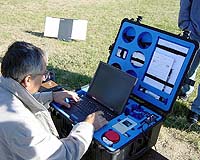
This image shows in-the-field medical equipment. The Portable Telemedical Workstation allows transmission of objective medical data (ECG, heart rate, oxygen satuation, blood pressure) and logistics data to the coordination and medical centre. It also provides audio communication via satellite link. The antenna can be seen in the background. Credits: SITEF

Paris, France (ESA) Jan 20, 2005
The ESA funded telemedicine project called I-DISCARE has been put into action to help victims along the coastal areas ravaged by last month's tsunami. It is being used to connect mobile teams of rescue workers with hospitals via satellite, greatly improving medical care.

On the initiative of the French Space Agency (CNES) with transport costs paid by them as well, three Portable Telemedicine Work (PTW) Stations have been lent to the Indian telemedicine company IndoComputech.

These are being used on the east coast of India by mobile teams of doctors and paramedics, connecting them with central hospitals at Lucknow, Madras and Ahmadabad.

A further five more Compact Data Terminals (CDT) are being used on the east coast of India by Mobile Sanitary teams. These teams are sending information on epidemiology as well as the quality and supply of water and nutrition to Public Health Institutions in New Delhi and SE coast District Centres.

Doctors and paramedics equipped with these Global Positioning System (GPS) capable terminals are better able to treat patients at the scene while still maintaining close contact with Mobile Field Hospitals, a Permanent Centre or Reference Hospital; even if located outside the country.

The result ensures earlier patient identification as well as quicker and more traceable data collection resulting in faster triage and better care.

Dr. Bernard Comet from MEDES: The Institute for Space Medicine and Physiology and Prime Contractor behind I-DISCARE said, "The quick availability of I-DISCARE makes it an excellent solution for these types of emergencies. I'm very pleased that we have been chosen to be a part of this very valuable endeavour."

I-DISCARE

I-DISCARE is a follow-up from an earlier ESA Telecom funded project DELTASS which completed just two years ago and stirred a great deal of media interest, proving that satellite systems can be both cost effective and adaptable to disaster situations where ground infrastructures are partly or completely destroyed.

I-DISCARE combined the talents of MEDES and Elsacom of Italy which acted as the satellite service provider and the Norwegian Centre for Telemedicine. The project concluded with a series of pilot deployments culminating in a large demonstration in Troms� Norway in October 2004.

The list of potential users is long, with any unit needing to work in remote areas under difficult conditions from humanitarian aid workers to emergency medical and rescue workers benefitting.

The I-DISCARE project team is presenting the final results of the ESA funded project at ESA/ESTEC Noordwijk, the Netherlands at 13:00 on 19 January 2005.
Related Links
ESA Telecom specialist site
ESA Telecom - Telemedicine
I-DISCARE
DELTASS
SpaceDaily
Search SpaceDaily
Subscribe To SpaceDaily Express

Nano World: DNA Meets Nanotechnology
New York (UPI) Jan 18, 2005
DNA and related nucleic acids help assemble life as we know it, but now scientists hope to employ those same complex molecules in nanotechnology to assemble electronics and even microscopic robots - in as soon as five years.


  • US Warned Not To Ignore Chinese Military Advances

  • U.S. Contingency Plan For Pakistani Nukes
  • Pentagon Denies Report US Forces Plan Air Strikes In Iran: Report
  • MTC Awarded Five-Year Contract to Provide Nuclear Treaties Monitoring
  • Outside View: Pakistan 'Tail' Wags U.S. 'Dog'

  • Taiwan Deploys Missiles On Mobile Launchers: Report
  • Russia, US Near Agreement On Controls For Portable Surface-To-Air Missiles
  • Taiwan Successfully Test-Fires Anti-Ship Missile: Report
  • ATK Test Demonstrates Pulse-Capable Solid Divert and Attitude Control System Design

  • Analysis: Missile Defense Semantics
  • US Missile Test Failure Caused By 'Minor' Glitch: General
  • LockMart Completes Testing Of Aegis BMD Initial Engagement Capability
  • Raytheon Delivers Five STANDARD Missile-3 Rounds For Aegis

  • India Ruins Pakistan's F-16 Shopping Spree
  • NASA's Famed B-52B "Mothership" Aircraft To Retire
  • EADS Faces Big Decision On Boeing Rival, Grapples With Internal Friction
  • Raytheon To Continue NASA Contract For Airspace Concepts Evaluation System

  • Geneva Aerospace Announces Production of its UAV Dakota Airframe
  • Sierra And Techsphere Recieve Order For High Altitude Airship
  • Raytheon to Build First Global Hawk Enhanced Integrated Sensor Suite
  • Honeywell Begins Flight Tests Of New 13-Inch Unmanned Aerial Vehicle


  • US Navy Commissions Northrop Grumman-Built Aegis Destroyer
  • Northrop Grumman Awarded $197 Million Contract For Work On USS Enterprise
  • Airbag Inflators Provide Push For New Surface Vessel Launcher
  • Russian Navy May Sink By 2008: Admiral

  • The content herein, unless otherwise known to be public domain, are Copyright 1995-2006 - SpaceDaily.AFP and UPI Wire Stories are copyright Agence France-Presse and United Press International. ESA PortalReports are copyright European Space Agency. All NASA sourced material is public domain. Additionalcopyrights may apply in whole or part to other bona fide parties. Advertising does not imply endorsement,agreement or approval of any opinions, statements or information provided by SpaceDaily on any Web page published or hosted by SpaceDaily. Privacy Statement