
 |
 |
 |
 |
 |
 |
 |
 |
 |
 |

| . |  |
. |

Sydney, Australia (SPX) Nov 18, 2010 In 2011, China will launch Tiangong 1, a small space laboratory. Later that year, China will perform its first docking test in space when the unmanned Shenzhou 8 spacecraft docks with Tiangong 1. In 2012, Shenzhou 9 will be launched, taking the first crew to the space laboratory. Television footage of Tiangong 1 has given us a fairly clear view of its exterior, but yielded little insight into its features or mission. The stubby spacecraft is basically a pressurized cylinder, with a smaller cylindrical service module at its rear. Two elements on its exterior do stand out. These are two seemingly identical cylinders, emerging in parallel from the spacecraft's mid-section, between the pressurized crew module and the service module. Obviously, Tiangong has two telescopes. It's less obvious to say what they can do, or what they will be used for. The telescopes appear to be identical in size and orientation. They're placed side by side, like a pair of binoculars. The telescopes are both oriented directly downwards, pointing towards the Earth. This, however, does not imply that they will be used for stereo imaging. In fact, two parallel instruments, so closely together, pointing at the same angle, aren't really useful for stereo imaging at all. The apertures and telescope housings are apparently the same, but it is probable that these are two very different devices. There's more than one strategy for deploying two instruments in this fashion. An obvious choice would be a narrow-angle and wide-angle view of the same scene. One telescope could take high-resolution pictures of a small patch of the ground. The other telescope could take a wider, low-resolution photograph of the same scene, with the footprint of the high-resolution telescope at its centre. The second telescope would be used as a "context camera", allowing the location of the high-resolution image to be exactly plotted on a map, by comparing the surrounding area. The two telescopes could also be operating in different spectral bands. One could be sensitive to visible light. The other could be more attuned to the infrared band. Multispectral imaging is a useful tool that allows minerals to be identified, plant health to be assessed, and the power output of machinery and infrastructure to be monitored. In such a case, the resolution and "footprint" of the camera views would both be roughly identical, and would overlap. The telescopes could also be serving as engineering tests, allowing new optical systems and electro- optical devices to be demonstrated. It is unlikely that the telescopes are designed for laser rangefinding or laser communications experiments. They are fairly fixed in their orientation, and would need to be pointing directly at the source or target. This would limit their effectiveness to very short overpasses of ground stations. It seems beyond question that both telescopes are entirely electronic, and would use CCD chips for image reception. Both telescopes are housed outside the laboratory's pressurized section, making access for astronauts difficult. This rules out any changes of film cartridges. Furthermore, the telescopes are likely to perform most of their work by remote control from Earth, and most of this will probably happen when the laboratory is unoccupied. Astronauts aboard a spacecraft cause vibrations and bumps that can disturb the alignment of instruments. This is one reason why most space remote sensing of the Earth is done from unmanned satellites. For most of its mission, Tiangong 1 itself will carry no crew, and there will be plenty of opportunity to use these instruments. By contrast, some of the experiments inside the laboratory will probably be inactive while the station is uncrewed. There could also be observations carried out by the astronauts themselves during their visits to the laboratory. It is widely believed that the Shenzhou 6 mission in 2005 carried out reconnaissance photography tests, with the astronauts operating the on-board cameras. China could compare the effectiveness of crew-tended observations versus unmanned observations with the same instruments on the same spacecraft. Careful censorship of interior photographs of Shenzhou 6 means that we don't know much about the cameras on board, but the very fact that the censorship was practiced hints at the military implications of these experiments. China's first manned space mission, Shenzhou 5, also provides some possible insight into Tiangong's telescopes. The forward orbital module of the spacecraft held two optical telescopes, one on its exterior, the other inside, and pointing through a window. Although the second telescope was inside the spacecraft, astronaut Yang Liwei did not touch it during the flight, as he never entered the module that held it after launch. Both instruments were close together, and pointing at the ground. Do these telescopes have anything in common with the ones on Tiangong? There's one other big question that's worth considering. What will the telescopes be trained upon? We can expect that they will be used for a variety of purposes, and focused on a variety of different places. Say cheese. Dr Morris Jones is an Australian space analyst and writer. Email morrisjonesNOSPAMhotmail.com. Replace NOSPAM with @ to send email.
Share This Article With Planet Earth
Related Links - The Chinese Space Program - News, Policy and Technology China News from SinoDaily.com

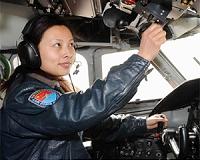 Chinese Female Taikonaut Identified
Onchan, UK (SPX) Nov 16, 2010 Sources in China have confirmed the identity of one of the two female Air Force pilots currently vying to become China's first woman in space. Captain Wang Yaping, 32, a Transport Pilot in the People's Liberation Army Air Force (PLAAF), and another currently unidentified colleague were selected in March, from a pool of fifteen female candidates, and joined five male jet fighter pilots to f ... read more |
|
|
| The content herein, unless otherwise known to be public domain, are Copyright 1995-2010 - SpaceDaily. AFP and UPI Wire Stories are copyright Agence France-Presse and United Press International. ESA Portal Reports are copyright European Space Agency. All NASA sourced material is public domain. Additional copyrights may apply in whole or part to other bona fide parties. Advertising does not imply endorsement,agreement or approval of any opinions, statements or information provided by SpaceDaily on any Web page published or hosted by SpaceDaily. Privacy Statement |


 del.icio.us
 Digg
Digg Reddit
 YahooMyWeb
 Google
 Facebook


