
 |
 |
 |
 |
 |
 |
 |
 |
 |
 |

| . |  |
. |

Chicago IL (SPX) Feb 14, 2011 NASA's Stardust spacecraft, equipped with the University of Chicago's Dust Flux Monitor Instrument (DFMI), is hurtling at more than 24,000 miles an hour toward a Valentine's Day encounter with comet Tempel 1. Stardust will approach to within 124 miles of Tempel 1 at 10:56 p.m. CST Monday, Feb. 14. The spacecraft flew within 150 miles of comet Wild 2 in 2004, when it collected thousands of tiny dust particles streaming from the comet's nucleus for laboratory analysis. The spacecraft dropped off the samples in a canister that parachuted onto the desert salt flats of Utah in January 2006 following a journey of nearly approximately 3.5 billion miles. But Stardust, still healthy and with fuel to spare, soon went back onto the interplanetary market, looking for a second mission. The mission will be the first to allow Thanasas Economou, Senior Scientist at UChicago's Enrico Fermi Institute, and his fellow members of the Stardust-NExT (New Exploration of Tempel) science team to look for changes on a comet's surface that occurred following an orbit around the sun. They will compare Stardust's data from Tempel 1 with findings from a previous probe that also studied that comet. "We are very excited that we can visit a second comet-comet Tempel 1-with the same spacecraft after we visited the Wild 2 comet in 2004," Economou said. "The Dust Flux Monitor Instrument is healthy and ready to take another look at this comet." Stardust had only one sample-return canister, so this time the spacecraft will be unable to capture cometary dust for analysis back on Earth. Few at the time thought that the spacecraft would be able to visit another comet, "but even so, we are looking forward to seeing what kind of results we will get," Economou said.
Sizing up a new crater The impact enabled scientists to study the composition of Tempel 1, a Jupiter-class comet whose orbit has been modified by close passages to the planet. Stardust now has the opportunity to collect additional data on how Jupiter-family comets formed and evolved. The DFMI was developed by Economou and the late John Simpson, the Arthur Holly Compton Distinguished Service Professor Emeritus in Physics, and the late Anthony Tuzzolino, Senior Scientist in UChicago's Fermi Institute. The instrument detected as many as several hundred particles each second during Stardust's flyby of comet Wild 2 in January 2004. Most of those particles measured no more than a few microns in diameter, too small to see with the naked eye. Just a few measured more than 10 microns, about one-fifth the diameter of a human hair. Tempel 1 has displayed less surface activity than did Wild 2, "but we are going there with a higher velocity, so probably the flux will be equal to or a little more than we had during the Wild 2 encounter," Economou said. The Tempel 1 flyby likely will be the last assignment for Stardust, which is running low on fuel after logging almost 3.7 billion miles in space since its launch in 1999. Economou, meanwhile, will continue his collaborations on NASA's Mars Exploration Rover mission and the Cassini mission to Saturn. He also is working to establish a new astronomical observatory near his childhood home in Ziakas, Greece. Jet Propulsion Laboratory Featured Scientist Interview with Thanasis Economou
Share This Article With Planet Earth
Related Links Stardust-NexT University of Chicago Asteroid and Comet Mission News, Science and Technology

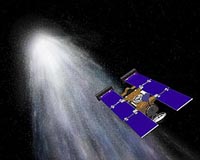 Stardust Heading Into The Bonus Round
Pasadena CA (JPL) Feb 11, 2011 A bonus round is something one usually associates with the likes of a TV game show, not a pioneering deep space mission. "We are definitely in the bonus round," said Stardust-NExT Project Manager Tim Larson of NASA's Jet Propulsion Laboratory in Pasadena, Calif. "This spacecraft has already flown by an asteroid and a comet, returned comet dust samples to Earth, and now has almost doubled its ori ... read more |
|
|
| The content herein, unless otherwise known to be public domain, are Copyright 1995-2010 - SpaceDaily. AFP and UPI Wire Stories are copyright Agence France-Presse and United Press International. ESA Portal Reports are copyright European Space Agency. All NASA sourced material is public domain. Additional copyrights may apply in whole or part to other bona fide parties. Advertising does not imply endorsement,agreement or approval of any opinions, statements or information provided by SpaceDaily on any Web page published or hosted by SpaceDaily. Privacy Statement |


 del.icio.us
 Digg
Digg Reddit
 YahooMyWeb
 Google
 Facebook


