
 |
 |
 |
 |
 |
 |
 |
 |
 |
 |

| . |  |
. |

Vancouver, Canada (SPX) Nov 30, 2010 UBC and TRIUMF physicists have proposed a unified explanation for dark matter and the so-called baryon asymmetry--the apparent imbalance of matter with positive baryon charge and antimatter with negative baryon charge in the Universe. The visible Universe appears to be made of atoms, and each of these atoms carries a positive baryon charge equal to total number of protons and neutrons in its nucleus. However, since the discovery of antimatter in 1932, researchers have wondered why the Universe doesn't hold a neutral baryon charge--requiring as much negatively charged antimatter as positively charged matter. This net asymmetry of particles over antiparticles remains one of the biggest unsolved mysteries in physics. "We've proposed a matter formation scenario where the positive baryon number of visible atoms is in balance with the equal and opposite negative baryon number of dark matter," says Kris Sigurdson, an assistant professor of Physics and Astronomy at UBC, who worked with colleagues at TRIUMF, Canada's National Laboratory for Particle Physics, and researchers at Brookhaven National Laboratory in the US, on the theory. "This links the formation of atoms and dark matter and helps resolve the baryon asymmetry mystery, as the total dark plus visible baryon balance of the Universe is restored." Observations of the the big bang's afterglow, the cosmic microwave background, by the WMAP satellite now show about 4.6 per cent of the Universe (by density) is comprised of atoms, with about five times more dark matter (23 per cent). The cosmic balancing act proposed by the researchers may explain why the measured densities of dark matter and atoms differ only by a factor of five. The researchers also predict an entirely new method to detect dark matter. "Occasionally a dark-matter antiparticle may collide with and annihilate an ordinary atomic particle, releasing a burst of energy," says Sigurdson. "While extremely rare, this means dark matter might be observed in nucleon decay experiments on Earth that look for the spontaneous decay of protons." Dark matter - first hinted at nearly 80 years ago - is an elusive material inferred to exist from measurements of its gravitational effects on visible matter in galaxies, background radiation, and the Universe as a whole. It interacts very weakly with ordinary matter and, while playing a key role in our Universe, is almost undetectable. Hooman Davoudiasl, Brookhaven National Laboratory, New York and David Morrissey and Sean Tulin of TRIUMF's Theory Group, co-authored the letter.
Share This Article With Planet Earth
Related Links University of British Columbia Stellar Chemistry, The Universe And All Within It

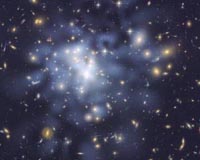 Detailed Dark Matter Map Yields Clues To Galaxy Cluster Growth
Baltimore MD (SPX) Nov 12, 2010 Astronomers using NASA's Hubble Space Telescope took advantage of a giant cosmic magnifying glass to create one of the sharpest and most detailed maps of dark matter in the universe. Dark matter is an invisible and unknown substance that makes up the bulk of the universe's mass. The new dark matter observations may yield new insights into the role of dark energy in the universe's early for ... read more |
|
|
| The content herein, unless otherwise known to be public domain, are Copyright 1995-2010 - SpaceDaily. AFP and UPI Wire Stories are copyright Agence France-Presse and United Press International. ESA Portal Reports are copyright European Space Agency. All NASA sourced material is public domain. Additional copyrights may apply in whole or part to other bona fide parties. Advertising does not imply endorsement,agreement or approval of any opinions, statements or information provided by SpaceDaily on any Web page published or hosted by SpaceDaily. Privacy Statement |


 del.icio.us
 Digg
Digg Reddit
 YahooMyWeb
 Google
 Facebook


