
 |
 |
 |
 |
 |
 |
 |
 |
 |
 |

| . |  |
. |

Chicago IL (SPX) Jul 20, 2010 The University of Chicago has joined the effort to build the world's largest telescope in Chile, which will eclipse the image quality even of the Hubble Space Telescope, as the quest continues for answers to some the deepest mysteries of modern cosmology. The University will provide $50 million to become a founding partner in the project called the Giant Magellan Telescope, which will be able to produce images of objects 100 times fainter than the Hubble Space Telescope can detect. "The University of Chicago's Department of Astronomy and Astrophysics is among the best astronomy and astrophysics departments in the country and worldwide," said Wendy Freedman, director of the Carnegie Observatories and chairperson of the GMT Organization. "This is exactly the kind of partner we need to make this ambitious telescope project a success." The other founding GMT partners are the Carnegie Institution for Science, University of Texas at Austin, Harvard University, Australian National University, Smithsonian Astrophysical Observatory, University of Arizona, Texas A and M University, Astronomy Australia Ltd., and the Korea Astronomy and Space Science Institute. Construction of the GMT will begin at Las Campanas Observatory, Chile, in 2012 and will take approximately seven years to complete. "Chicago has a great tradition in exploring the universe," said Robert Kirshner, Harvard's Clowes Professor of Science. "At the founding of the university, Chicago built the world's largest telescope at Yerkes, Chicago trained Edwin Hubble, the leading astronomer of the 20th century, and now they're looking to be leaders in the field for the 21st century." UChicago also has committed an additional $14 million to join the related consortium that currently operates the twin 6.5-meter Magellan Telescopes at Las Campanas. These arrangements guarantee that UChicago scientists will receive a share of observing time on the telescopes, a critical component of pioneering cosmological research. "The twin Magellan Telescopes give our astronomers immediate access to some of the best optical telescopes in the world," said Edward "Rocky" Kolb, chairman of UChicago's Department of Astronomy and Astrophysics. "We're looking to make great discoveries with the Magellan Telescopes. They will be the workhorses of the department in optical astronomy for the next 10 years." These telescopes are necessary tools for prying loose answers to the mysteries of dark energy and dark matter, two of the biggest questions confronting modern cosmologists, Kolb said. Dark energy is a repulsive force of unknown origin that is accelerating the expansion of the universe. Dark matter is a material of unknown composition that is far more plentiful in the universe than the ordinary matter of everyday life. Theories and observations have convinced most cosmologists that dark energy and dark matter exist in huge amounts, but their precise nature has remained elusive. The Magellan Telescopes will complement UChicago research at the South Pole Telescope and in the Dark Energy Survey. "Even now, the South Pole Telescope is discovering sources that are being followed up by observations at the Magellan Telescopes," Kolb said. "The important thing for the department is to have not just one facility, but an array of these different facilities to do the science that we want to do." Beyond the next decade, UChicago astronomers will turn to the next-generation GMT to make their optical observations. In addition to research on dark energy and dark matter, the GMT will be capable of searching for planets around stars other than the sun. "This is part of the goal of looking for Earth-like planets around other stars that could be the sites for life," Kolb said. "This is one of the new avenues that the Giant Magellan Telescope will open, in addition to being able to look at the sky with unprecedented resolution and light-gathering power." The $700 million GMT will combine seven 8.4-meter primary mirror segments into the equivalent of a 24.5-meter telescope (nearly 82 feet). The first mirror, now under development at the Steward Observatory Mirror Lab at the University of Arizona, will be completed late this year. UChicago has a deep historical link to the Carnegie Observatories through its founder, George Ellery Hale (1868-1938). Hale founded UChicago's Department of Astronomy and Astrophysics in the 1890s and became the founding director of Yerkes Observatory in Williams Bay, Wis., in 1897. A Chicago native, Hale later founded the Mount Wilson and Palomar observatories, today known as the Carnegie Observatories, in southern California. "Hale spent a great part of his life and career building the biggest telescopes in the world at that time," Freedman said. "He started out at Chicago doing just that, and he ended up at Carnegie continuing to do that. So the idea that both institutions would come together in the future, I suspect, would really please him."
Share This Article With Planet Earth
Related Links University of Chicago Space Telescope News and Technology at Skynightly.com

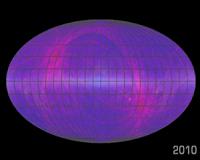 NASA's WISE Mission To Complete Extensive Sky Survey
Pasadena CA (SPX) Jul 19, 2010 NASA's Wide-field Infrared Survey Explorer, or WISE, will complete its first survey of the entire sky on July 17, 2010. The mission has generated more than one million images so far, of everything from asteroids to distant galaxies. "Like a globe-trotting shutterbug, WISE has completed a world tour with 1.3 million slides covering the whole sky," said Edward Wright, the principal investiga ... read more |
|
|
| The content herein, unless otherwise known to be public domain, are Copyright 1995-2010 - SpaceDaily. AFP and UPI Wire Stories are copyright Agence France-Presse and United Press International. ESA Portal Reports are copyright European Space Agency. All NASA sourced material is public domain. Additional copyrights may apply in whole or part to other bona fide parties. Advertising does not imply endorsement,agreement or approval of any opinions, statements or information provided by SpaceDaily on any Web page published or hosted by SpaceDaily. Privacy Statement |


 del.icio.us
 Digg
Digg Reddit
 YahooMyWeb
 Google
 Facebook


