
 |
 |
 |
 |
 |
 |
 |
 |
 |
 |

| . |  |
. |

London, UK (SPX) Nov 07, 2010 UK scientists working on the Large Hadron Collider's (LHC's) ALICE experiment at CERN are today celebrating the LHC's latest achievement which opens up an entirely new avenue of exploration. The successful collision of lead ions in the accelerator at record energies allows matter to be probed as it would have been in the first moments of the Universe's existence. This new phase of the LHC's program comes after seven months of successfully colliding protons at high energies. The UK work on the ALICE experiment is funded by the Science and Technology Facilities Council (STFC) with physicists from the University of Birmingham playing a key role. "We are thrilled with the achievement!" said Dr. David Evans from the University of Birmingham. "The collisions generated mini Big Bangs and the highest temperatures and densities ever achieved in an experiment." "This process took place in a safe, controlled environment generating incredibly hot and dense sub-atomic fireballs with temperatures of over ten trillion degrees, a million times hotter than the centre of the Sun", Dr. Evans added. "At these temperatures even protons and neutrons, which make up the nuclei of atoms, melt resulting in a hot dense soup of quarks and gluons known as a Quark-Gluon Plasma. By studying this plasma, physicists hope to learn more about the Strong Force, one of the four fundamental forces of nature. "The Strong Force not only binds the nuclei of atoms together but is responsible for 98% of their mass. I now look forward to studying a tiny piece of what the universe was made of just a millionth of a second after the Big Bang". "I am so excited that the ALICE experiment is finally going to be able to glimpse lead ion collisions from the LHC," said Birmingham University PhD student, Zoe Matthews. "The environment the collisions will create is mind-blowing, and observing them will offer up insights about the earliest moments in our universe's life. I feel so lucky to be a small part of this exciting piece of history." The 10,000 ton ALICE experiment has been specifically designed to study the extreme conditions produced in these lead collisions. Whilst the conditions created in the LHC detector will be a world record for manmade experiments and represent a great achievement for science and engineering, they pose no threat. More energetic particle reactions occur regularly throughout the Universe, including in the upper atmosphere of the Earth itself. ALICE is one of the four main experiments at the LHC designed to study the physics from ultra-high energy proton-proton and lead-lead interactions.
Share This Article With Planet Earth
Related Links Alice at Cern CERN LHC Understanding Time and Space

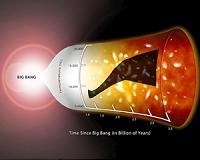 Astronomers Find Evidence Of Cosmic Climate Change
London, UK (SPX) Nov 04, 2010 A team of astronomers has found evidence that the universe may have gone through a warming trend early in its history. They measured the temperature of the gas that lies in between galaxies, and found a clear indication that it had increased steadily over the period from when the universe was one tenth to one quarter of its current age. This cosmic climate change is most likely caused by t ... read more |
|
|
| The content herein, unless otherwise known to be public domain, are Copyright 1995-2010 - SpaceDaily. AFP and UPI Wire Stories are copyright Agence France-Presse and United Press International. ESA Portal Reports are copyright European Space Agency. All NASA sourced material is public domain. Additional copyrights may apply in whole or part to other bona fide parties. Advertising does not imply endorsement,agreement or approval of any opinions, statements or information provided by SpaceDaily on any Web page published or hosted by SpaceDaily. Privacy Statement |


 del.icio.us
 Digg
Digg Reddit
 YahooMyWeb
 Google
 Facebook


