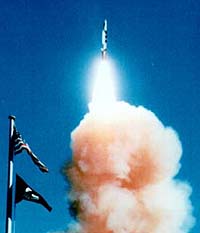
File photo: U.S. Navy Standard Missile 2 Block IV.
File photo: U.S. Navy Standard Missile 2 Block IV. |
The U.S. Navy has now made seven ballistic missile intercepts from eight firings, but until this point all of the engagements had occurred with the BMD-dedicated SM-3 in the exo-atmospheric ballistic phases, the report said.
Nick Bucci, Lockheed Martin's chief engineer for Sea-based Missile Defence, told Jane's that both types of engagement had stressing moments, but the main difference with a terminal phase engagement was the timeline involved. Otherwise the Aegis engagement path follows the same detect, track, engage and control sequence.
There are currently no more trials scheduled for the SM-2 terminal BMD capability in the short term and this demonstration was primarily to prove that the concept was technically possible.
The U.S. Navy has large stocks of existing SM-2 missiles that it could upgrade with the modified seeker. Jim Sheridan, Lockheed Martin's director of Aegis Development, told Jane's that rolling out the Aegis terminal phase upgrade across the 15 destroyers and three cruisers of the BMD fleet was an option.
Related Links
 Rafael Selected For Short-Range Ballistic Missile Defense Interceptor Development
 Tucson AZ (SPX) May 30, 2006
| The content herein, unless otherwise known to be public domain, are Copyright 1995-2006 - SpaceDaily.AFP and UPI Wire Stories are copyright Agence France-Presse and United Press International. ESA PortalReports are copyright European Space Agency. All NASA sourced material is public domain. Additionalcopyrights may apply in whole or part to other bona fide parties. Advertising does not imply endorsement,agreement or approval of any opinions, statements or information provided by SpaceDaily on any Web page published or hosted by SpaceDaily. Privacy Statement |