|
 |
 |
 |
 |
 |
 |
 |
 |
 |

| . |  |
. |
US Officials Review Satellite Images For Clues To Missing Explosives Cache
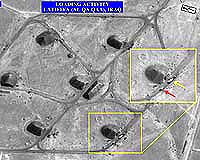
Washington (AFP) Oct 28, 2004 US officials are reviewing satellite images and reports from UN nuclear watchdog inspectors to determine what happened to nearly 400 tons of explosives missing from a looted Iraqi weapons site, an issue now at the forefront of the US presidential race, US defense officials said Thursday. Questions remained as to the volume of explosives at the site before the US-led invasion, when the explosives were last seen by international inspectors, what US forces found at the site - and if they did find explosives, what actions they took. Democratic challenger John Kerry has made the missing explosives the central theme on the last days of campaigning for the White House, describing the incident as a symbol of President George W. Bush's failures. Bush, at first slow to react, accused Kerry of making "wild charges" about the explosives and of saying "anything to get elected." Pentagon officials and military commanders have suggested the explosives may have been moved while the site was still under the control of Saddam Hussein's regime, noting that the Iraqis dispersed weapons and ammunition before the US-led invasion. "We have people who are trying to review what satellite surveillance may have taken place, and having reviewed it what it may mean," Lawrence DiRita, the Pentagon spokesman said. DiRita urged caution in treating reports that satellite photos taken shortly before the war showed large trucks at the site. State Department officials and others were also going through reports from International Atomic Energy Agency (IAEA) inspectors on the explosives cache. "They had a lot of reports. It's complicated to go through and track and make sure we understand how these reports add up. People are doing that now," DiRita said. The explosives went missing from the Al-Qaqaa compound, a sprawling facility some 48 kilometers (30 miles) south of Baghdad. IAEA teams last visited Al-Qaqaa shortly before the March 19, 2003 US-led invasion. The UN inspectors said they had put 377 tons of high explosives at the site under seal. US forces moved in and out of the area between April 3 and May 27, 2003, according to the Pentagon. The first known US military unit to arrive at Al-Qaqaa was the 3rd Infantry Division, which on April 3 dispatched elements of a battalion to suppress Iraqi fire from the compound and secure a nearby bridgehead over the Euphrates river. Once inside, the soldiers found a vast storage facility with about 80 buildings and 30 to 40 bunkers, some with open doors, said Colonel Dave Perkins, the commander of the division's 2nd Brigade. Soldiers saw some conventional munitions and a white powdery substance they initially feared might be a chemical or biological agent, he said. Tests proved the substance was not dangerous. But Perkins said his soldiers performed only a cursory search because their priority was to press on to Baghdad. By April 6 they had moved on. On April 10, troops from the 101st Airborne Division came through Al-Qaqaa. The Pentagon said they remained on the edge of the depot, and the division said it had no orders to search and secure the site or to search for high explosives. It remains unclear whether the Al Qaqaa was under guard or even visited by US forces after a final visit May 27 by a US team hunting for weapons of mass destruction. All rights reserved. � 2004 Agence France-Presse. Sections of the information displayed on this page (dispatches, photographs, logos) are protected by intellectual property rights owned by Agence France-Presse. As a consequence, you may not copy, reproduce, modify, transmit, publish, display or in any way commercially exploit any of the content of this section without the prior written consent of Agence France-Presse. Related Links SpaceDaily Search SpaceDaily Subscribe To SpaceDaily Express  RT Logic Delivers Satellite Baseband Systems To Eads Astrium
 Colorado Springs CO (SPX) Oct 28, 2004
RT Logic, a wholly owned subsidiary of Integral Systems Wednesday today announced that EADS Astrium (England) has completed the final stages of operational testing with the RT Logic provided Telemetrix satellite baseband systems. |
|
|

| The content herein, unless otherwise known to be public domain, are Copyright 1995-2006 - SpaceDaily.AFP and UPI Wire Stories are copyright Agence France-Presse and United Press International. ESA PortalReports are copyright European Space Agency. All NASA sourced material is public domain. Additionalcopyrights may apply in whole or part to other bona fide parties. Advertising does not imply endorsement,agreement or approval of any opinions, statements or information provided by SpaceDaily on any Web page published or hosted by SpaceDaily. Privacy Statement |