|
 |
 |
 |
 |
 |
 |
 |
 |
 |

| . |  |
. |
Unity House: A Prototype For 21st Century Homebuilding
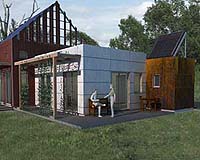
Unity ME (SPX) May 05, 2008 Unlike people, not all houses are created equal. Now, even the most entrenched principles around which houses have been built are being challenged. Todays builders of tomorrows homes are addressing a whole new reality: that to be truly durable and sustainable, houses should be able to adapt to homeowners needs over time. Moreover, this adaptability must be achieved with minimal impact to the environment. This involves nothing less than the reinvention of the home. But, how do you change a building industry that has held fast to conventional wisdom? According to the OPEN Prototype Initiative (OPI), the answer lies in the Open-Built system of home construction, the nexus of future homebuilding. OPI is a program of the MIT House_n Research Consortium, Bensonwood Homes, and other industry partners. Its goal is to improve homebuilding across the country and to make homes more affordable, adaptable, and environmentally friendly. OPI has developed a process that makes it possible to construct thousands of environmentally friendly Net-Zero homes (which produce as much energy as they consume) and is sharing these innovations with the entire building industry. There are countless examples of green homes, but the industry has not developed a process to affordably mass produce these homes, said Kent Larson, director of the MIT House_n Research Consortium. The OPEN Prototype Initiative has developed scalable processes, such as prefabrication and the separation of core services that, when followed, enable builders to create thousands of customizable Net-Zero homes that are being made more affordable right now. OPEN_1, the first house built by OPI, used green building concepts such as energy-efficient wall, window, roof, and lighting systems; advanced tracking of energy use; and provisions for the best possible indoor air quality. The design and construction processes of the Open-Built system demonstrate ways building assemblies can be fabricated off-site, with integrated systems for plumbing, heating and cooling, and exterior siding. Off-site pre-finishing of construction elements allows for faster on-site assembly and thousands of pounds of less waste and debris. The second home being built by the OPI, dubbed Unity House, is the on-campus home for the president of Unity College. Unity College is a small school in Unity, Maine, with an environmentally focused curriculum. It was important to Mitch Thomashow, the President of Unity College (author of two well-known books on environmentalism), that his home reflect the colleges environmental commitment. The house is scheduled to be assembled on-site in May and will serve as a single family residence, an on-campus meeting and entertaining space, as well as a classroom -- all possible because of Open-Built technologies. Designed for Net-Zero energy use, the 1,930 square foot home will achieve LEED Platinum standards (Leadership in Energy and Environmental Design), feature a photovoltaic (PV) solar panel array, and be a living classroom for college students. Because of these attributes and its advanced prefabrication techniques, Unity House will be featured on an upcoming episode of This Old House, the PBS television home improvement series. Unity House and the OPEN Prototype Initiative embody the principles of Unity College, including environmental leadership, sustainability, and collaborative and experiential learning, said Thomashow. We are Americas environmental college, and with Unity House we are proud to be a part of an effort to reframe Americas building industry, making the mass-production of custom environmentally friendly homes a reality. A key to the OPI, and one of the main elements that separates the home and the building process from other green or prototype home projects, is the use of Open-Built principles. Open-Built thinking takes a layered approach to building, with each layer defined by its life span and anticipated need for future alteration. The high quality homes resulting from this process are built rapidly and with minimal waste. Homeowners can easily move or remove walls and fixtures, access swiftly evolving technologies or adapt the home to the changing needs of the occupants. For example, Unity House can be altered at its core, allowing walls to be moved or removed with the use of simple tools, rather than dealing with the mess of tearing down sheetrock. Preproduction in a controlled shop environment improves the quality of the home while reducing on-site waste. The average new homebuilding project today creates 8,000 pounds of on-site waste and can take from 9 months to a year or more to complete. Goals for the entire Unity House project include producing less than three barrels of on-site waste and completing on-site construction in only 20 working days. The architects/designers for Unity House are Hilary Harris and Randall Walter of Bensonwood Homes, with input from Kent Larson at MIT. Harris is a certified expert in environmental design and co-author of the Vermont Builds Greener Program, which certifies residential buildings constructed to sustainable criteria. She believes its not enough for a home just to be green; it also must be flexible enough to meet the individual needs of homeowners. Very few people have the ability today to design and build a home that meets their needs, adds Harris. Beyond just outlining a way to affordably build green homes, this initiative shows we can and should be building homes that can fit the needs of the homeowner, rather than forcing them to live within the current design of the house. What good is a green home if it cant adapt to change? Tedd Benson, the founder of Bensonwood Homes, is nationally recognized for revitalizing and modernizing the timberframe industry three decades ago. Over the years Bensonwood Homes has continued to be a leading innovator, being among the first American builders to use Computer Numerically Controlled (CNC) machinery and one of the first to adopt 3-D modeling software for home design. But far and away the greatest innovation of Bensonwood, and central to this project, is in taking open building to a whole new level of sophistication, integrating all the layers of houses into a modern, Open-Built design and manufacturing process. Benson and MITs Larson believe OPI is creating a blueprint for a better way to build homes. Ultimately, the OPEN Prototype Initiative will lead to greater efficiencies, says Benson. When architects, builders, and suppliers begin adopting Open-Built technologies, homes will become disentangled, enabling the industry to create a series of standardized systems and processes that increase efficiency and reduce costs, without sacrificing creativity. Community Email This Article Comment On This Article Related Links OPEN Prototype Initiative Powering The World in the 21st Century at Energy-Daily.com
 Consumers Warming To LEDs As An Energy-Efficient Solution For Lighting
 Melville NY (SPX) May 02, 2008
With consumer interest in energy-efficient lighting growing rapidly, the next wave of mass-market residential and business lighting could be coming from LEDs - light-emitting diodes, also known as solid-state lighting. That's the key finding of a new consumer survey commissioned by Arrow Electronics. The survey was conducted for Arrow by Harris Interactive. |
|
|

| The content herein, unless otherwise known to be public domain, are Copyright 1995-2007 - SpaceDaily.AFP and UPI Wire Stories are copyright Agence France-Presse and United Press International. ESA Portal Reports are copyright European Space Agency. All NASA sourced material is public domain. Additional copyrights may apply in whole or part to other bona fide parties. Advertising does not imply endorsement,agreement or approval of any opinions, statements or information provided by SpaceDaily on any Web page published or hosted by SpaceDaily. Privacy Statement |