|
 |
 |
 |
 |
 |
 |
 |
 |
 |

| . |  |
. |
Universe Slightly Simpler Than Expected
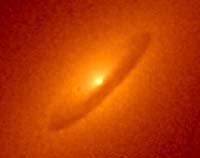
Gainesville - Jun 22, 2003 The universe just became a little less mysterious. Using images from the Hubble Space Telescope, astronomers at the University of Florida have concluded that two of the most common types of galaxies in the universe are in reality different versions of the same thing. In spite of their similar-sounding names, astronomers had for decades considered "dwarf elliptical" and "giant elliptical" galaxies to be unique. The findings, which appear in this month's edition of The Astronomical Journal, fundamentally alter astronomers' understanding of these important components of the universe, making it easier to understand how galaxies form in the first place. "This helps to simplify the universe because we replace two distinct galaxy types with one," said Alister Graham, a UF astronomer and lead author of the paper. "But the implications go beyond mere astronomical taxonomy. Astronomers had thought the formation mechanisms for these objects must be different, but instead there is a unifying construction process." Galaxies, the building blocks of the visible universe, are enormous systems of stars bound together by gravity and scattered throughout space. There are several different types, or shapes. For example, the Milky Way galaxy, in which the Earth resides, is a "spiral" galaxy, so named because its disk-like shape has an embedded spiral arm pattern. Other galaxies are known as "irregular" galaxies because they do not have distinct shapes. But together, dwarf and giant elliptical galaxies are the most common. For the past two decades, astronomers have considered giant elliptical galaxies, which contain hundreds of billions of stars, and dwarf elliptical galaxies, which typically contain less than one billion stars, as completely separate systems. In many ways it was a natural distinction: Not only do giant elliptical galaxies contain more stars, but the stars also are more closely packed toward the centers of such galaxies. In other words, the overall distribution of stars appeared to be fundamentally different. Graham, a postdoctoral research associate, and Rafael Guzm�n, a UF associate professor of astronomy, decided to take a second look at the accepted wisdom. The pair analyzed images of dwarf elliptical galaxies taken by the Hubble Space Telescope and combined their results with previously collected data on over 200 galaxies. The resulting sample revealed that the structural properties of the galaxies varied continuously between the allegedly different dwarf and giant galaxy classes -- in other words, these two types were just relatively extreme versions of the same object. Sidney van den Bergh, former director and researcher emeritus at the Dominion Astrophysical Observatory at the National Research Council of Canada in Victoria, said Graham and Guzm�n's result puts to rest a "very puzzling" question. "In astronomy, like in physical anthropology, there is a deep connection between the classification of species and their evolutionary connections," van den Bergh said. "The bottom line is that the new work of Graham and Guzm�n has made life a little bit simpler for those of us who want to understand how galaxies are formed and have evolved." Graham and three colleagues expand on his and Guzm�n's conclusions with a separate article that appears in the same issue of The Astronomical Journal. In recent years, Graham said, a number of studies had revealed that the innermost centers of giant elliptical galaxies -- the inner 1 percent -- had been scoured out or emptied of stars. Astronomers suspect that massive black holes are responsible, gravitationally hurling away any stars that ventured too near and devouring the stars that came in really close. This scouring phenomenon had tended to dim the centers of giant elliptical galaxies, which ran counter to the trend that bigger galaxies tend to have brighter centers. The dimming phenomenon was also one reason astronomers had concluded dwarf and giant galaxies must be different types. Building on recent revelations showing a strong connection between the mass of the central black holes and the properties of their host galaxies, Graham and his colleagues introduced a new mathematical model that simultaneously describes the distribution of stars in the inner and outer parts of the galaxy. "It was only after allowing for the modification of the cores by the black holes that we were able to fully unify the dwarf and giant galaxy population," Graham said. Peter Erwin and Andres Asensio Ramos of the Instituto de Astrof�sica de Canarias in Spain, and Ignacio Trujillo of the Max-Planck Institut f�r Astronomie in Germany, worked with Graham to support his conclusions. Both research projects were funded in part by NASA and the American Astronomical Society. Related Links Astronomy at University of Florida SpaceDaily Search SpaceDaily Subscribe To SpaceDaily Express  Deuteron-Gold Collisions Intensify Search For New Form Of Matter
 Upton - Jun 18, 2003
The latest results from the Relativistic Heavy Ion Collider (RHIC), the world's most powerful facility for nuclear physics research, strengthen scientists' confidence that RHIC collisions of gold ions have created unusual conditions and that they are on the right path to discover a form of matter called the quark-gluon plasma, believed to have existed in the first microseconds after the birth of the universe.
--------------------------------------------------------- It's new. And it's downright terrific! Celestron's CPC Schmidt-Cassegrain telescope is the scope you've been waiting for! It offers new alignment technology, advanced engineering, and bold new design at a new, low price! In fact, Celestron's Professional Computerized (CPC) scope with revolutionary SkyAlign Alignment Technology redefines everything that amateur astronomers are looking for. It offers quick and simple alignment, GPS technology, unsurpassed optical quality, ease of use, advanced ergonomics, enhanced computerization and, most important, affordability. Want to view M-31 tonight? One button takes you there!
Shop for telescopes online at Telescopes.com! today!
|
|
|

| The content herein, unless otherwise known to be public domain, are Copyright 1995-2006 - SpaceDaily.AFP and UPI Wire Stories are copyright Agence France-Presse and United Press International. ESA PortalReports are copyright European Space Agency. All NASA sourced material is public domain. Additionalcopyrights may apply in whole or part to other bona fide parties. Advertising does not imply endorsement,agreement or approval of any opinions, statements or information provided by SpaceDaily on any Web page published or hosted by SpaceDaily. Privacy Statement |