|
 |
 |
 |
 |
 |
 |
 |
 |
 |

| . |  |
. |
Unlocking The Frozen Secrets Of Comet Wild 2
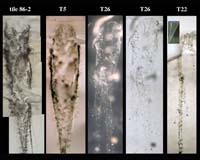
Washington DC (SPX) Dec 20, 2006 Eleven months ago, NASA's Stardust mission touched down in the Utah desert with the first solid comet samples ever retrieved from space. Since then, nearly 200 scientists from around the globe have studied the minuscule grains, looking for clues to the physical and chemical history of our solar system. Although years of work remain to fully decipher the secrets of comet Wild 2, researchers are sure that it contains some of the most primitive and exotic chemical structures ever studied in a laboratory. Preliminary results appear in a special section of the December 15 issue of Science. Overall, research efforts have focused on answering "big-picture" questions regarding the nature of the comet samples that were returned, including determining mineral structures, chemical composition, and the chemistry of the organic, or carbon-containing, compounds they carry. Carnegie researchers made key contributions to the latter effort. Out of seven papers in total, four involved Carnegie scientists from the Geophysical Laboratory (GL) and the Department of Terrestrial Magnetism (DTM). "Carnegie enjoys a unique concentration of instrumentation and expertise to be able to engage in cutting-edge questions such as those posed by the Stardust mission," said GL's Andrew Steele. Scientists have believed that comets formed long ago in the cool outer reaches of the solar system and thus largely consist of material that formed at cold temperatures and escaped alteration in the blast furnace of the inner solar nebula-the cloud of hot gases that condensed to form the Sun and terrestrial planets some 4.5 billion years ago. According to the record contained in the Stardust grains, it appears that this hypothesis is about 90% right. Evidence from the ratios of certain isotopes-variants of atoms that have the same chemical properties, yet differ in weight-suggest that as much as 10% of the comet's material formed in the hot inner solar nebula and was transported to the cold outer reaches where the comet came together as the Sun formed. Chief among these tell-tale isotopes are those of oxygen, for which the ratios resemble those seen in meteorites known to have formed in the inner solar system. Yet, isotopic measurements of hydrogen and nitrogen made at DTM and elsewhere tell a different picture. "The presence of excesses of heavier isotopes-deuterium and nitrogen 15, to be specific-is a strong indication that some of the comet dust was around before the Sun formed," said DTM's Larry Nittler. "It's really quite striking." The structures of the comet's organic molecules tell a similar tale. "This comet's organic material is really quite unusual compared to other extraterrestrial sources we have studied, such as meteorites and interstellar dust particles," said GL's George Cody. "Yet there are some important similarities that tell that us we are not dealing with matter that is totally foreign to our solar system." The samples contain very few of the stable ringed, or aromatic, carbon structures that are common on Earth and in meteorites. Instead, they have many fragile carbon structures that would most likely not have survived the harsh conditions in the solar nebula. These molecules also contain considerably more oxygen and nitrogen than even the most primordial examples retrieved from meteorites and exist in forms that are new to meteorite studies. "These forms of carbon don't look like what we find in meteorites, which is something like compacted soot from your chimney. The carbon compounds from this comet are a much more complicated mix of compounds," commented GL's Marc Fries. "It will be an exciting challenge to explain how these compounds formed and wound up in the comet." "This leads us to our next big question," Cody remarked. "How could such fragile material have survived capture at 6 km/sec collision velocity?" "At this point, every question we answer raises several more questions," Nittler said. "But that is precisely what makes exploration so exciting and makes sample return so important. We now have the samples to study for many years to come." Related Links NASA Stardust mission The Iron and Ice Of Our Solar System  NASA Study Finds New Kind of Organics in Stardust Mission
 Pasadena CA (JPL) Dec 15, 2006
A team of scientists found a new class of organics in comet dust captured from Comet Wild 2 in 2004 by NASA's Stardust spacecraft. The discovery is described in a technical paper, "Organics Captured from Comet Wild 2 by the Stardust Spacecraft," in the Dec. 15, 2006, issue of Science Express, the online edition of the journal Science. |
|
|

| The content herein, unless otherwise known to be public domain, are Copyright 1995-2006 - SpaceDaily.AFP and UPI Wire Stories are copyright Agence France-Presse and United Press International. ESA PortalReports are copyright European Space Agency. All NASA sourced material is public domain. Additionalcopyrights may apply in whole or part to other bona fide parties. Advertising does not imply endorsement,agreement or approval of any opinions, statements or information provided by SpaceDaily on any Web page published or hosted by SpaceDaily. Privacy Statement |