|
 |
 |
 |
 |
 |
 |
 |
 |
 |

| . |  |
. |
Venus And Jupiter Converge
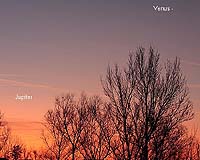
for NASA Science News Washington DC (SPX) Jan 31, 2008 Wake up before dawn on an arctic-cold February morning .... and go outside? This Friday you'll be glad you did. The two brightest planets in the Solar System, Venus and Jupiter, are converging for a spectacular close encounter. The best time to look: Friday morning, February 1st. Venus and Jupiter will be so close together, you can hide them behind the tip of your index finger held at arm's length. You'll need a clear view of the southeastern horizon to see the show. Venus and Jupiter will be hanging low, like landing airplanes, easily hidden behind tall buildings or trees. So go out beforehand (at noon when it is warmer) and find a gap to look through so you won't have to hunt for one in the dark on Friday. It's worth the effort because Venus and Jupiter will be less than 1o apart, like twin headlights piercing the rosy glow of sunrise. It's a beautiful scene. In fact, you may not be able to take your eyes off of it. Venus and Jupiter are literally spellbinding. There is a physiological basis for this phenomenon. When two planets appear so close together, they grab an extra share of your brain's attention. Consider the following: "Your eye is like a digital camera," explains Dr. Stuart Hiroyasu, O.D., of Bishop, California. "There's a lens in front to focus the light, and a photo-array behind the lens to capture the image. The photo-array in your eye is called the retina. It's made of rods and cones, the fleshy organic equivalent of electronic pixels." Near the center of the retina lies the fovea, a patch of tissue 1.5 millimeters wide where cones are extra-densely packed. "Whatever you see with the fovea, you see in high-definition," he says. The fovea is critical to reading, driving, watching television. The fovea has the brain's attention. The field of view of the fovea is only about five degrees wide. On Friday morning, Venus and Jupiter will fit together inside that narrow angle, signaling to the brain, "this is worth watching!" If you can tear your eyes off Venus and Jupiter, glance to the right: Another close encounter is underway. The crescent Moon appears directly beside the red giant star Antares. With only 2 degrees between them, the Moon and Antares will fit inside your fovea as well. Friday morning should not be missed, but if you do miss it, don't worry, the show continues as February unfolds. Venus and Jupiter will remain relatively close together for several days to come while the Moon moves in to join them. Mornings of note include Sunday, Feb. 3rd, when the Moon, Venus and Jupiter arrange themselves in a slightly-bent line, and Monday, Feb. 4th, when the trio form one of the most exquisite celestial triangles you'll ever see. Community Email This Article Comment On This Article Related Links Jupiter and its Moons Explore The Ring World of Saturn and her moons The million outer planets of a star called Sol News Flash at Mercury
 Monster Storms Erupt On Jupiter
 Greenbelt MD (SPX) Jan 29, 2008
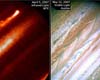
As the largest planet in our solar system, Jupiter likes to supersize its stormy weather. Two giant storms erupted from a jet stream blowing at 370 miles per hour on Jupiter in March, 2007. The storms exploded in size, growing from 250 miles across to more than 1,245 miles across in less than a day. Ice plumes from the storms towered 20 miles above surrounding cloud tops. The storms disturbed the jet and formed in their wake swirling red clouds that spread around the planet. |
|
|

| The content herein, unless otherwise known to be public domain, are Copyright 1995-2007 - SpaceDaily.AFP and UPI Wire Stories are copyright Agence France-Presse and United Press International. ESA Portal Reports are copyright European Space Agency. All NASA sourced material is public domain. Additional copyrights may apply in whole or part to other bona fide parties. Advertising does not imply endorsement,agreement or approval of any opinions, statements or information provided by SpaceDaily on any Web page published or hosted by SpaceDaily. Privacy Statement |