
 |
 |
 |
 |
 |
 |
 |
 |
 |
 |

| . |  |
. |
Venus Comes To Life At Wavelengths Invisible To Human Eyes
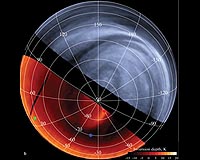
Paris, France (ESA) Dec 04, 2008 A pale yellow dot to the human eye, Earth's twin planet comes to life in the ultraviolet and the infrared. New images taken by instruments on board ESA's Venus Express provide insight into the turbulent atmosphere of our neighbouring planet. Using Venus Express, it is possible to compare what the planet looks like in different wavelengths, giving scientists a powerful tool to study the physical conditions and dynamics of the planet's atmosphere. Observed in the ultraviolet, Venus shows numerous high-contrast features. The cause is the inhomogeneous distribution of a mysterious chemical in the atmosphere that absorbs ultraviolet light, creating the bright and dark zones. The ultraviolet reveals the structure of the clouds and the dynamical conditions in the atmosphere, whereas the infrared provides information on the temperature and altitude of the cloud tops. With data from Venus Express, scientists have learnt that the equatorial areas on Venus that appear dark in ultraviolet light are regions of relatively high temperature, where intense convection brings up dark material from below. In contrast, the bright regions at mid-latitudes are areas where the temperature in the atmosphere decreases with depth. The temperature reaches a minimum at the cloud tops suppressing vertical mixing. This annulus of cold air, nicknamed the 'cold collar', appears as a bright band in the ultraviolet images. Observations in the infrared have been used to map the altitude of the cloud tops. Surprisingly, the clouds in both the dark tropics and the bright mid-latitudes are located at about the same height of about 72 km. At 60 degrees south, the cloud tops start to sink, reaching a minimum of about 64 km, and form a huge hurricane at the pole. This study, carried out by D. Titov and colleagues has revealed that variable temperature and dynamical conditions at the Venus cloud tops are the cause of the global ultraviolet pattern. But the exact chemical species that creates the high-contrast zones still remains elusive, and the search is on. Share This Article With Planet Earth
Related Links Looking at Venus Venus Express News and Venusian Science
 Venus Express Searching For Life On Earth
 Paris, France (ESA) Oct 13, 2008
Scientists using ESA's Venus Express are trying to observe whether Earth is habitable. Silly, you might think, when we know that Earth is richly stocked with life. In fact, far from being a pointless exercise, Venus Express is paving the way for an exciting new era in astronomy. |
|
|

| The content herein, unless otherwise known to be public domain, are Copyright 1995-2007 - SpaceDaily.AFP and UPI Wire Stories are copyright Agence France-Presse and United Press International. ESA Portal Reports are copyright European Space Agency. All NASA sourced material is public domain. Additional copyrights may apply in whole or part to other bona fide parties. Advertising does not imply endorsement,agreement or approval of any opinions, statements or information provided by SpaceDaily on any Web page published or hosted by SpaceDaily. Privacy Statement |
 del.icio.us
 Digg
Digg Reddit
 YahooMyWeb
 Google
 Facebook