
. Military Space News .
Venus Disappears During Meteor Shower

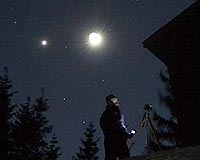
A Venus-Moon conjunction.
by Dr. Tony Phillips
for NASA Science News
Huntsville AL (SPX) Apr 20, 2009
April 17, 2009: Picture this: It's 4:30 in the morning. You're up and out before the sun. Steam rises from your coffee cup, floating up to the sky where a silent meteor streaks through a crowd of stars. A few minutes later it happens again, and again. A meteor shower is underway.

One of the streaks leads to the eastern horizon. There, just above the tree line, Venus and the crescent Moon hover side by side, so close together they almost seem to touch. Suddenly, Venus wavers, winks, and disappears.

All of this is about to happen--for real.

On Wednesday morning, April 22nd, Earth will pass through a stream of comet dust, giving rise to the annual Lyrid meteor shower. At the same time, the crescent Moon and Venus will converge for a close encounter in the eastern sky. Viewed from some parts of the world, the Moon will pass directly in front of Venus, causing Venus to vanish.

The source of the meteor shower is Comet Thatcher. Every year in late April, Earth passes through the comet's trail of debris. Flakes of comet dust, most no bigger than grains of sand, strike Earth's atmosphere traveling 110,000 mph and disintegrate as fast streaks of light.

A typical Lyrid shower produces 10 to 20 meteors per hour over the northern hemisphere, not an intense display. Occasionally, however, Earth passes through a dense region of the comet's tail and rates increase five- to ten-fold. In 1982, observers counted 90 Lyrids per hour. Because Thatcher's tail has never been mapped in detail, the outbursts are unpredictable and could happen again at any time. The probabilities are highest during the dark hours before sunrise on April 22nd.

The Moon-Venus conjunction is pure coincidence. It has nothing to do with the Lyrid display other than insurance. Even if the shower fizzles, the sight of a 9% crescent Moon located so close to brilliant Venus is guaranteed to make your day.

Most observers will see only a close gathering of the two bodies. People in western parts of North America are favored with more--a full-blown eclipse or "occultation." Around 5 a.m. Pacific Daylight Time, Venus will disappear behind the mountainous rim of the Moon and reappear 60 to 90 minutes later. Click on the map for local details:

Do not worry if the sun rises during the occultation, because Venus and the Moon are bright enough to see in broad daylight. Locate the pair before sunrise, so you know where they are, then follow them up the brightening sky using binoculars or naked eyes. Some people say Venus and the Moon are most beautiful when surrounded by morning blue.

On Wednesday morning, April 22nd, you can see for yourself.

Share This Article With Planet Earth
del.icio.usdel.icio.us DiggDigg RedditReddit
YahooMyWebYahooMyWeb GoogleGoogle FacebookFacebook


Related Links
The Lyrid Meteor Shower
Asteroid and Comet Impact Danger To Earth - News and Science


Memory Foam Mattress Review
Newsletters :: SpaceDaily :: SpaceWar :: TerraDaily :: Energy Daily
XML Feeds :: Space News :: Earth News :: War News :: Solar Energy News


NASA Team Finds Riches In Meteorite Treasure Hunt
Washington DC (SPX) Mar 30, 2009
Just before dawn on Oct. 7, 2008, an SUV-sized asteroid entered Earth's atmosphere and exploded harmlessly over the Nubian Desert of northern Sudan. Scientists expected the asteroid, called 2008 TC3, had blown to dust in the resulting high-altitude fireball.


  • Future Of NATO Will Be Determined In Afghanistan Part Six
  • NATO Bloated And Weakened From Expansion Part Two
  • Australia must boost military to deal with China rise: think tank
  • The Future Of NATO Part Five

  • Analysis: Ending Iranian nuclear conflict
  • US nuclear experts expelled from NKorea: Xinhua
  • BMD Watch: S-400s For Belarus Part Two
  • UN nuclear inspectors quit NKorea, US team to follow

  • USAF Awards Raytheon Contract For Laser-Guided Maverick Missile
  • Raytheon Standard Missile-2 Destroys Target
  • Indian tests cruise missile: official
  • US says warships deployed before NKorea launch

  • THAAD Launchers And Fire Control And Communications Units Rolled Out
  • Russia still wary of US missile shield: Lavrov
  • Israel-US to hold missile intercept drill: report
  • BMD Focus: Russia boosts ICBM arsenal

  • China Eastern Airlines reports huge loss in 2008
  • Airlines fear failure of global climate talks
  • State takes control of China's first private airline: report
  • Troubled private Chinese airline says president missing

  • Boeing Demonstrates Command And Control Of ScanEagle From Wedgetail
  • Raven UAS Achieves 30-Hour Persistent Surveillance
  • Russia Defense Watch: UAVs from Israel
  • Pakistan highlights 'gap' with US over drone attacks

  • Suicide bomber wounds 38 at Iraqi army base
  • US must stay engaged in Iraq despite Afghanistan: analysts
  • Commentary: Gulf war jitters
  • US, Iraqi forces launch major operation in Kirkuk

  • Northrop Grumman Upgrades Ship Navigation Radars With Enhanced Naval Display Features
  • Boeing Awarded US Navy Contract to Develop Free Electron Laser
  • Land Rover Launches Versatile New Discovery Armoured
  • Boeing Teams With TAK To Develop Wing Assembly For 2,000-Pound JDAM ER

  • The content herein, unless otherwise known to be public domain, are Copyright 1995-2007 - SpaceDaily.AFP and UPI Wire Stories are copyright Agence France-Presse and United Press International. ESA Portal Reports are copyright European Space Agency. All NASA sourced material is public domain. Additional copyrights may apply in whole or part to other bona fide parties. Advertising does not imply endorsement,agreement or approval of any opinions, statements or information provided by SpaceDaily on any Web page published or hosted by SpaceDaily. Privacy Statement