
 |
 |
 |
 |
 |
 |
 |
 |
 |
 |

| . |  |
. |
Venus Express Provides First Detection Of Hydroxyl In Atmosphere Of Venus
Paris, France (ESA) May 20, 2008 The VIRTIS instrument on Venus Express has made the first detection of hydroxyl in the atmosphere of Venus. This provides new insight into the dynamics of the upper atmosphere and the climate system of the planet. The results are published in the May 2008 issue of Astronomy and Astrophysics. Measurements of airglow emission from planets is an important tool in understanding the chemical and dynamical processes that control the composition and energy balance in the upper atmosphere of planets. Observations of night-side airglow emission optimises the detection of the weak light that is otherwise swamped by scattered sunlight on the day side of the planet. Airglow from NO and O2(a-X)(0-0) has already been detected on Venus. In the May issue of A and A Picconi et al. report the first detection of hydroxyl (OH) in the night-side airglow emission of Venus. This is the first detection of OH in the atmosphere of a planet other than Earth. The data were recorded by the VIRTIS instrument, during one orbit of Venus, in March 2007. Observations were made in limb mode, which is favourable when searching for faint emission. The resulting long path length along the line of sight can produce an amplification of the signal of a factor of 50. The OH is unambiguously identified in the 1.40-1.49 and 2.6-3.14 bands for the (2-0) and (1-0) transitions respectively. Identification was made by comparing the observed spectra with synthetic spectra for 200, 250 and 300 K. In addition the spectra show O2 emission at 1.27 and 1.58. This is the first detection of the latter band in the spectrum of another planet, and the first simultaneous detection of both bands on any planet. Intensity distributions of the hydroxyl bands appear to be closely correlated with those of the oxygen bands. While the data are consistent with either of two mechanisms of production involving H, O3, O and HO2, the authors favour the Bates-Nicolet mechanism. These results provide the most direct observational constraints to date of these key species in the chemistry of the upper atmosphere of Venus. Community Email This Article Comment On This Article Share This Article With Planet Earth
Related Links Venus Express News and Venusian Science
 Key Molecule Found In Venus Atmosphere
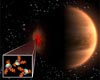 Paris, France (ESA) May 16, 2008
Venus Express has detected the molecule hydroxyl on another planet for the first time. This detection gives scientists an important new tool to unlock the workings of Venus's dense atmosphere. |
|
|

| The content herein, unless otherwise known to be public domain, are Copyright 1995-2007 - SpaceDaily.AFP and UPI Wire Stories are copyright Agence France-Presse and United Press International. ESA Portal Reports are copyright European Space Agency. All NASA sourced material is public domain. Additional copyrights may apply in whole or part to other bona fide parties. Advertising does not imply endorsement,agreement or approval of any opinions, statements or information provided by SpaceDaily on any Web page published or hosted by SpaceDaily. Privacy Statement |

 del.icio.us
 Digg
Digg Reddit
 YahooMyWeb
 Google
 Facebook