|
 |
 |
 |
 |
 |
 |
 |
 |
 |

| . |  |
. |
Whole Body Regeneration From A Blood Vessel
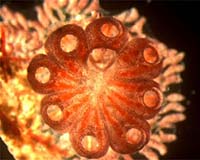
Haifa, Israel (SPX) Mar 07, 2007 For a lucky subset of vertebrates, losing an appendage is no big deal. As many an inquisitive child knows, salamanders can regenerate lost limbs or tails; and as lab investigators know, zebrafish can regrow lost fins. Of course, humans and other "higher" vertebrates must make do with repairing rather than regenerating damaged tissues. Though whole body generation (WBR) does occur, it's typically restricted to a subset of morphologically less complex invertebrates, such as sponges, flatworms, and jellyfish. In a new study, Yuval Rinkevich et al. discovered an unusual mode of WBR in our closest invertebrate relative, the sea squirt Botrylloides leachi. Sea squirts (also called "tunicates" after their tough outer tunic) are widely distributed in shallow coastal waters as colonies of genetically identical individuals called "zooids." To investigate WBR in B. leachi, Rinkevich et al. collected colonies from the Mediterranean coast of Israel and analyzed the morphological, cellular, and molecular characteristics of the process. The researchers removed fragments of blood vessels with ampullae from the colonies, and placed the fragments on slides for regeneration. Of 95 fragments, 80 underwent WBR. Aggregating cells formed around a hollow sphere, then reorganized into a thin and thick layer on opposite sides, very similar to early stages of embryonic development. As cells proliferated, buds grew and the thick cell layer folded inward, forming double-walled folds and chambers. Organ development continued and an adult zooid, capable of sexual reproduction, appeared within two weeks. For molecular insights into regeneration, the researchers focused on retinoic acid (RA) signaling by examining the temporal expression of its receptor (RAR). In addition to its role in chordate body patterning, RA (a vitamin A metabolite) induces the regeneration of several tissues and organs. Only regenerating vessels and ampullae expressed RAR, and this expression continued through each phase of regeneration. The researchers confirmed RA's vital role in regeneration by inhibiting RA synthesis with chemicals and destroying RA transcripts with RNA interference. In both cases, malformed buds failed to generate zooids from dissected fragments. Similar problems occurred when RAR function was disrupted. In contrast, RA overexpression led to accelerated regeneration, with multiple buds reaching the fully developed zooid stage. RAR regulates developmental elements of the normal budding process in a sister colonial tunicate species, suggesting that organisms recruit the same signals for development and regeneration. In regenerating fully functional adult tunicates from "minute vascular fragments," the researchers identified several features of this system that differ from those of established regeneration model systems. In contrast to limb or fin regeneration, which arises from local signals emanating from a "regeneration center," B. leachi WBR arises from systemically induced signals in multiple "regeneration niches." These niches arise from the vascular network (rather than from proliferating balls of cells), and regeneration appears to be regulated by systemic (rather than local) cues. These systemic cues, the researchers propose, may travel through the circulation, thereby supporting multiple regeneration foci. The researchers plan to investigate the cellular source of the tunicate's remarkable regenerative power in future studies. As invertebrate members of the phylum Chordata, sea squirts share several fundamental biological pathways with vertebrates; consequently, using them as a model system to study WBR could illuminate not only the evolutionary origin of regeneration, but also its subsequent attenuation in vertebrates. Citation: Rinkevich Y, Paz G, Rinkevich B, Reshef R (2007) Systemic bud induction and retinoic acid signaling underlie whole body regeneration in the urochordate Botrylloides leachi. PLoS Biol 5(4): e71. doi:10.1371/journal.pbio.0050071. Email This Article
Related Links  Washington DC (SPX) Feb 28, 2007
Are bigger bones stronger bones? Not necessarily, according to a recent NASA study that seeks to ensure healthy bones in astronauts. A four-year study of the long-term effects of microgravity on the bones of International Space Station crew members showed that the astronauts, on average, lost roughly 11 percent of their total hip bone mass over the course of their mission. |
|
|

| The content herein, unless otherwise known to be public domain, are Copyright 1995-2006 - SpaceDaily.AFP and UPI Wire Stories are copyright Agence France-Presse and United Press International. ESA PortalReports are copyright European Space Agency. All NASA sourced material is public domain. Additionalcopyrights may apply in whole or part to other bona fide parties. Advertising does not imply endorsement,agreement or approval of any opinions, statements or information provided by SpaceDaily on any Web page published or hosted by SpaceDaily. Privacy Statement |