
 |
 |
 |
 |
 |
 |
 |
 |
 |
 |

| . |  |
. |
Yale Astronomer Discovers Upper Mass Limit For Black Holes
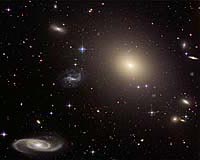
New Haven CT (SPX) Sep 17, 2008 There appears to be an upper limit to how big the universe's most massive black holes can get, according to new research led by a Yale University astrophysicist. Once considered rare and exotic objects, black holes are now known to exist throughout the universe, with the largest and most massive found at the centers of the largest galaxies. These "ultra-massive" black holes have been shown to have masses upwards of one billion times that of our own Sun. Now, Priyamvada Natarajan, an associate professor of astronomy and physics at Yale University and a fellow at the Radcliffe Institute for Advanced Study, and Ezequiel Treister, a postdoctoral fellow at the University of Hawaii, have shown that even the biggest of these gravitational monsters can't keep growing forever. Instead, they appear to curb their own growth - once they accumulate about 10 billion times the mass of the Sun. These ultra-massive black holes, found at the centers of giant elliptical galaxies in huge galaxy clusters, are the biggest in the known universe. Even the large black hole at the center of our own Milky Way galaxy is thousands of times less massive than these behemoths. But these gigantic black holes, which accumulate mass by sucking in matter from neighboring gas, dust and stars, seem unable to grow beyond this limit regardless of where - and when - they appear in the universe. "It's not just happening today," said Natarajan. "They shut off at every epoch in the universe." The study, to appear in the Monthly Notices of the Royal Astronomical Society (MNRAS), represents the first time an upper mass limit has been derived for black holes. Natarajan and Treister used existing optical and X-ray data of these ultra-massive black holes to show that, in order for those various observations to be consistent, the black holes must essentially shut off at some point in their evolution. One possible explanation put forth by Natarajan is that the black holes eventually reach the point when they radiate so much energy as they consume their surroundings that they end up interfering with the very gas supply that feeds them, which may interrupt nearby star formation. The new findings have implications for the future study of galaxy formation, since many of the largest galaxies in the universe appear to co-evolve along with the black holes at their centers. "Evidence has been mounting for the key role that black holes play in the process of galaxy formation," said Natarajan. "But it now appears that they are likely the prima donnas of this space opera." The authors of the paper are Priyamvada Natarajan (Yale University and the Radcliffe Institute for Advanced Study) and Ezequiel Treister (European Southern Observatory, Chile and University of Hawaii). Community Email This Article Comment On This Article Share This Article With Planet Earth
Related Links Yale University Understanding Time and Space
 Virtual Telescope Zooms In On Super-Massive Black Hole At Heart Of Milky Way
 Cambridge MA (SPX) Sep 04, 2008
An international team, led by astronomers at the MIT Haystack Observatory, has obtained the closest views ever of what is believed to be a super-massive black hole at the center of the Milky Way galaxy. |
|
|

| The content herein, unless otherwise known to be public domain, are Copyright 1995-2007 - SpaceDaily.AFP and UPI Wire Stories are copyright Agence France-Presse and United Press International. ESA Portal Reports are copyright European Space Agency. All NASA sourced material is public domain. Additional copyrights may apply in whole or part to other bona fide parties. Advertising does not imply endorsement,agreement or approval of any opinions, statements or information provided by SpaceDaily on any Web page published or hosted by SpaceDaily. Privacy Statement |
 del.icio.us
 Digg
Digg Reddit
 YahooMyWeb
 Google
 Facebook