|
|
|
|
|
|
|
|
|
|
|


| . |  |
. |
|
|
|
 by Staff Writers Washington DC (SPX) Aug 29, 2014
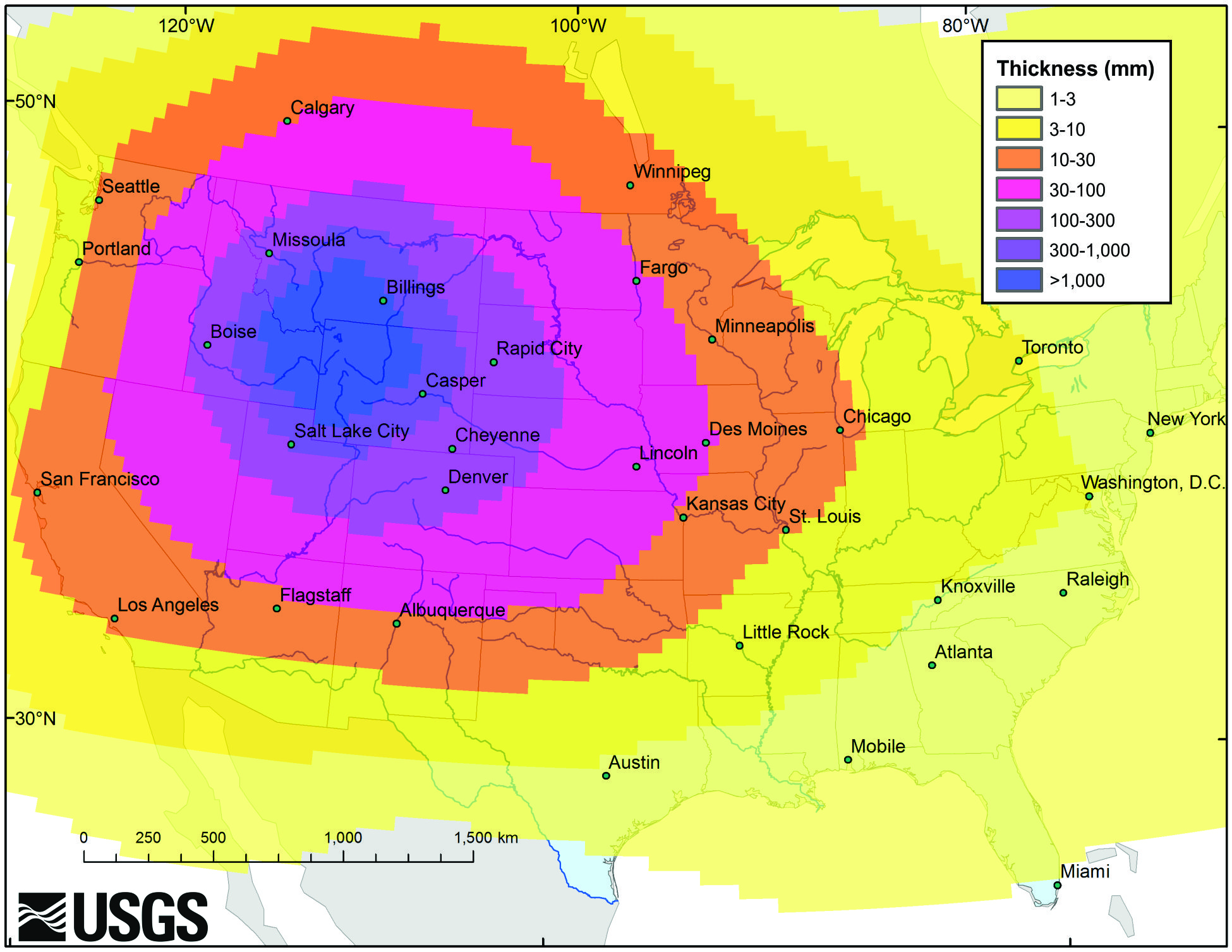
In the unlikely event of a volcanic supereruption at Yellowstone National Park, the northern Rocky Mountains would be blanketed in meters of ash, and millimeters would be deposited as far away as New York City, Los Angeles and Miami, according to a new study. An improved computer model developed by the study's authors finds that the hypothetical, large eruption would create a distinctive kind of ash cloud known as an umbrella, which expands evenly in all directions, sending ash across North America. A supereruption is the largest class of volcanic eruption, during which more than 1,000 cubic kilometers (240 cubic miles) of material is ejected. If such a supereruption were to occur, which is extremely unlikely, it could shut down electronic communications and air travel throughout the continent, and alter the climate, the study notes. A giant underground reservoir of hot and partly molten rock feeds the volcano at Yellowstone National Park. It has produced three huge eruptions about 2.1 million, 1.3 million and 640,000 years ago. Geological activity at Yellowstone shows no signs that volcanic eruptions, large or small, will occur in the near future. The most recent volcanic activity at Yellowstone-a relatively non-explosive lava flow at the Pitchstone Plateau in the southern section of the park-occurred 70,000 years ago. Researchers at the U.S. Geological Survey used a hypothetical Yellowstone supereruption as a case study to run their new model that calculates ash distribution for eruptions of all sizes. The model, Ash3D, incorporates data on historical wind patterns to calculate the thickness of ash fall for a supereruption like the one that occurred at Yellowstone 640,000 years ago. The new study provides the first quantitative estimates of the thickness and distribution of ash in cities around the U.S. if the Yellowstone volcanic system were to experience this type of huge, yet unlikely, eruption. Cities close to the modeled Yellowstone supereruption could be covered by more than a meter (a few feet) of ash. There would be centimeters (a few inches) of ash in the Midwest, while cities on both coasts would see millimeters (a fraction of an inch) of accumulation, according to the new study that was published online today in Geochemistry, Geophysics, Geosystems, a journal of the American Geophysical Union. The paper has been made available at no charge here. The model results help scientists understand the extremely widespread distribution of ash deposits from previous large eruptions at Yellowstone. Other USGS scientists are using the Ash3D model to forecast possible ash hazards at currently restless volcanoes in Alaska. Unlike smaller eruptions, whose ash deposition looks roughly like a fan when viewed from above, the spreading umbrella cloud from a supereruption deposits ash in a pattern more like a bull's eye - heavy in the center and diminishing in all directions - and is less affected by prevailing winds, according to the new model. "In essence, the eruption makes its own winds that can overcome the prevailing westerlies, which normally dominate weather patterns in the United States," said Larry Mastin, a geologist at the USGS Cascades Volcano Observatory in Vancouver, Washington, and the lead author of the new paper. Westerly winds blow from the west. "This helps explain the distribution from large Yellowstone eruptions of the past, where considerable amounts of ash reached the west coast," he added. The three large past eruptions at Yellowstone sent ash over many tens of thousands of square kilometers (thousands of square miles). Ash deposits from these eruptions have been found throughout the central and western United States and Canada. Erosion has made it difficult for scientists to accurately estimate ash distribution from these deposits. Previous computer models also lacked the ability to accurately determine how the ash would be transported. Using their new model, the study's authors found that during very large volcanic eruptions, the expansion rate of the ash cloud's leading edge can exceed the average ambient wind speed for hours or days depending on the length of the eruption. This outward expansion is capable of driving ash more than 1,500 kilometers (932 miles) upwind - westward - and crosswind - north to south - producing a bull's eye-like pattern centered on the eruption site. In the simulated modern-day eruption scenario, cities within 500 kilometers (311 miles) of Yellowstone like Billings, Montana, and Casper, Wyoming, would be covered by centimeters (inches) to more than a meter (more than three feet) of ash. Upper Midwestern cities, like Minneapolis, Minnesota, and Des Moines, Iowa, would receive centimeters (inches), and those on the East and Gulf coasts, like New York and Washington, D.C. would receive millimeters or less (fractions of an inch). California cities would receive millimeters to centimeters (less than an inch to less than two inches) of ash while Pacific Northwest cities like Portland, Oregon, and Seattle, Washington, would receive up to a few centimeters (more than an inch). Even small accumulations only millimeters or centimeters (less than an inch to an inch) thick could cause major effects around the country, including reduced traction on roads, shorted-out electrical transformers and respiratory problems, according to previous research cited in the new study. Prior research has also found that multiple inches of ash can damage buildings, block sewer and water lines, and disrupt livestock and crop production, the study notes. The study also found that other eruptions - powerful but much smaller than a Yellowstone supereruption - might also generate an umbrella cloud. "These model developments have greatly enhanced our ability to anticipate possible effects from both large and small eruptions, wherever they occur," said Jacob Lowenstern, USGS Scientist-in-Charge of the Yellowstone Volcano Observatory in Menlo Park, California, and a co-author on the new paper.
Related Links American Geophysical Union Bringing Order To A World Of Disasters When the Earth Quakes A world of storm and tempest
|
|
|
| The content herein, unless otherwise known to be public domain, are Copyright 1995-2014 - Space Media Network. All websites are published in Australia and are solely subject to Australian law and governed by Fair Use principals for news reporting and research purposes. AFP, UPI and IANS news wire stories are copyright Agence France-Presse, United Press International and Indo-Asia News Service. ESA news reports are copyright European Space Agency. All NASA sourced material is public domain. Additional copyrights may apply in whole or part to other bona fide parties. Advertising does not imply endorsement, agreement or approval of any opinions, statements or information provided by Space Media Network on any Web page published or hosted by Space Media Network. Privacy Statement All images and articles appearing on Space Media Network have been edited or digitally altered in some way. Any requests to remove copyright material will be acted upon in a timely and appropriate manner. Any attempt to extort money from Space Media Network will be ignored and reported to Australian Law Enforcement Agencies as a potential case of financial fraud involving the use of a telephonic carriage device or postal service. |

 del.icio.us
 Digg
Digg Reddit
 Google