|
 |
 |
 |
 |
 |
 |
 |
 |
 |

| . |  |
. |
Yes, It Is The Image Of An Exoplanet
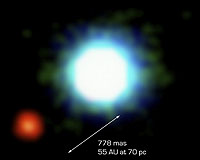
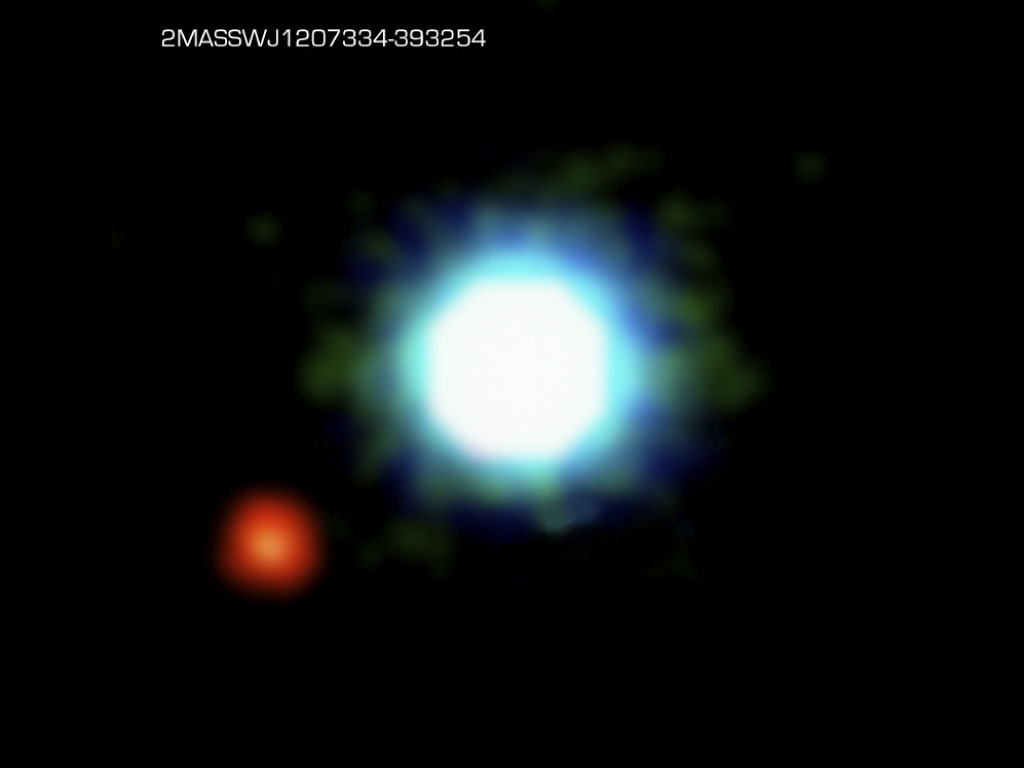
Garching, Germany (SPX) May 02, 2005 Astronomers have confirmed the first image of a planet outside of our Solar System. An international team of astronomers recently reported confirmation of the discovery of a giant planet, approximately five times the mass of Jupiter, that is gravitationally bound to a young brown dwarf. This puts an end to a year long discussion on the nature of this object, which started with the detection of a red object close to the brown dwarf. In February and March of this year, the astronomers took new images of the young brown dwarf and its giant planet companion with the state-of-the-art NACO instrument on ESO's Very Large Telescope in northern Chile. The planet is near the southern constellation of Hydra, approximately 200 light years from the Earth. "Our new images show convincingly that this really is a planet, the first planet that has ever been imaged outside of our solar system," tells Gael Chauvin, astronomer at ESO and leader of the team of astronomers who conducted the study. "The two objects - the giant planet and the young brown dwarf - are moving together; we have observed them for a year, and the new images essentially confirm our 2004 finding," says Benjamin Zuckerman, UCLA professor of physics and astronomy, member of NASA's Astrobiology Institute, and a member of the team. "I'm more than 99 percent confident." The planet is located at a distance of 55 AU from it host brown dwarf. Anne-Marie Lagrange, another member of the team from the Grenoble Observatory in France, looks towards the future: "Our discovery represents a first step towards one of the most important goals of modern astrophysics: to characterize the physical structure and chemical composition of giant and, eventually, terrestrial-like planets." Last September, the same team of astronomers reported a faint reddish speck of light in the close vicinity of a young brown dwarf (see ESO PR 23/04). The feeble object, now called 2M1207b, is more than 100 times fainter than the brown dwarf, 2M1207A. The spectrum of 2M1207b presents a strong signature of water molecules, thereby confirming that it must be cold. Based on the infrared colours and the spectral data, evolutionary model calculations led to the conclusion that 2M1207b is a 5 Jupiter-mass planet. Its mass can be estimated also by use of a different method of analysis, which focuses on the strength of its gravitational field; this technique suggests that the mass might be even less than 5 Jupiters. At the time of its discovery in April 2004, it was impossible to prove that the faint source is not a background object (such as an unusual galaxy or a peculiar cool star with abnormal infrared colours), even though this appeared very unlikely. Observations with the Hubble Space Telescope, obtained in August 2004, corroborated the VLT/NACO observations, but were taken too soon after the NACO ones to conclusively demonstrate that the faint source is a planet. The new observations show with high confidence that the two objects are moving together and hence are gravitationally bound. "Given the rather unusual properties of the 2M1207 system, the giant planet most probably did not form like the planets in our solar system," says Gael Chauvin. "Instead it must have formed the same way our Sun formed, by a one-step gravitational collapse of a cloud of gas and dust." The paper describing this research has been accepted for publication in Astronomy and Astrophysics. The same European/American team has had another paper just accepted for publication in Astronomy & Astrophysics; this paper reports the imaging discovery with the same VLT/NACO instrumentation of a lightweight companion to AB Pictoris, a young star located about 150 light years from Earth. The estimated mass of the companion is between 13 and 14 times the mass of Jupiter, which places the companion right on the border line between massive planets and the lowest mass brown dwarfs. Related Links ESO's NaCo instrument SpaceDaily Search SpaceDaily Subscribe To SpaceDaily Express  NASA's Spitzer Telescope Sees Signs Of Alien Asteroid Belt
 Pasadena CA (JPL) Apr 21, 2005
NASA's Spitzer Space Telescope has spotted what may be the dusty spray of asteroids banging together in a belt that orbits a star like our Sun. |
|
|

| The content herein, unless otherwise known to be public domain, are Copyright 1995-2006 - SpaceDaily.AFP and UPI Wire Stories are copyright Agence France-Presse and United Press International. ESA PortalReports are copyright European Space Agency. All NASA sourced material is public domain. Additionalcopyrights may apply in whole or part to other bona fide parties. Advertising does not imply endorsement,agreement or approval of any opinions, statements or information provided by SpaceDaily on any Web page published or hosted by SpaceDaily. Privacy Statement |