|
 |
 |
 |
 |
 |
 |
 |

| . |  |
. |

|
|
. |

 by Staff Writers Paris (ESA) May 30, 2011
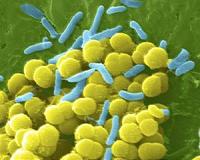
Technology developed with ESA funding and drawing on long-running research aboard the International Space Station is opening up a new way to keep hospital patients safe from infections. Using plasma - superheated, electrically charged gas - Max Planck Institute for Extraterrestrial Physics director Gregor Morfill is developing ways to kill bacteria and viruses that can cause infections in hospitals. "What we have with plasma is the possibility to supplement our own immune system," says Dr Morfill. The research began on the International Space Station (ISS), where his ESA-funded physics experiments have been running since 2001. The first was 'Plasmakristall Experiment Nefedov' in cooperation with Russian partners. Later, the PK-3 Plus and PK-4 experiments flew in 2006 as part of ESA's Astrolab mission. "It's the longest-running space experiment in the history of human spaceflight," notes Dr Morfill. More than two dozen astronauts and cosmonauts have operated the equipment aboard the ISS. The work in space led to the realisation that plasma might have very practical terrestrial applications - and Dr Morfill turned to ESA's Technology Transfer Programme to make it a reality. Plasma dispensers can tackle a serious problem: in recent years, health experts have seen a dramatic rise in super-strains of bacteria that can survive the strongest antibiotics in medicine's arsenal. One, the multiple drug-resistant Staphylococcus aureus - perhaps better known as MRSA - kills 37 000 people each year in the EU alone. It affects more than 150 000 patients, resulting in extra in-hospital costs of 380 million euro for EU healthcare systems. With help from ESA, Dr Morfill's team is now focusing on developing a system for hospitals, but cold plasma technology might one day also make it into our homes. Plasma could be used to disinfect toothbrushes and razors instead of UV light, which only sanitises the surfaces it shines on. Plasma-charged gas would clean in hidden cracks and crevices, too. At the other end of the spectrum, he says that plasma could be used as a 'planetary protection system' to clean satellites and planetary probes so they don't carry terrestrial bacteria to distant planets. The technology looks likely to do a lot of good. Bacteria are constantly evolving, developing resistance to the most commonly used antibiotics. Today, the best way to prevent the spread of bacterial infections is sanitation: regular hand washing between patients, for example, and systematic sanitising of floors, door handles, hospital curtains and anything else that might harbour infectious material. Instead, Dr Morfill is designing a system that makes use of plasma's innate antibacterial properties to make disinfection easy and quick. "It has many practical applications, from hand hygiene to food hygiene, disinfection of medical instruments, personal hygiene, even dentistry - this could be used in many, many fields." Dr Morfill adds that the research on the ISS and support from ESA has played an important role in turning physics experiments into life-saving technology here on Earth, both directly through ESA funding of a technology demonstrator project and through classic 'trickle down' of the specific technology transfer. "ESA has been tremendously helpful - we're 90% funded by ESA," Dr Morfill concludes. "Funding for doing experimental work in the laboratory and in space has made it possible to spin off and start other research." More on ESA's Technology Transfer Programme and its Technology Transfer Demonstrator projects on ESA TTP website.
|
. |
|
| The content herein, unless otherwise known to be public domain, are Copyright 1995-2011 - Space Media Network. AFP and UPI Wire Stories are copyright Agence France-Presse and United Press International. ESA Portal Reports are copyright European Space Agency. All NASA sourced material is public domain. Additional copyrights may apply in whole or part to other bona fide parties. Advertising does not imply endorsement,agreement or approval of any opinions, statements or information provided by Space Media Network on any Web page published or hosted by Space Media Network. Privacy Statement |

 del.icio.us
 Digg
Digg Reddit
 Google