|
 |
 |
 |
 |
 |
 |
 |
 |
 |

| . |  |
. |
"Zero G and I Feel Fine"
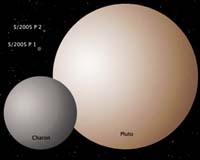
Baltimore MD (SPX) Mar 21, 2006 It's been over three weeks since I last filed a PI's Perspective, so there is a lot to catch you up on. We're more than 60 days into flight now, and in every respect, New Horizons is doing fine. As you probably already know, our third and last post-launch Trajectory Correction Maneuver (TCM-3), a clean up tweak of a bout 2.6 miles/hour was successfully executed on March 9th. TCM-3 featured the first in flight closed-loop burn control, in which the onboard nav system senses the acceleration of the vehicle and targets the burn cutoff for a precise change in velocity. This worked entirely as advertised, and it's a capability we plan to use in future burns, rather than just conducting the burn with a timer. On the day following TCM-3, the mission control team uploaded the Command Loss Time Safety New (CLTSN) autonomy "catcher's mitt" code that I wrote about last month. Also this month, we have continued the in flight testing of our SWAP and PEPSSI plasma instruments. SWAP also passed a major milestone on March 13th by successfully opening their launch door-on the first try--I might add. That's the second launch door to open, since Alice opened hers in late February. Still to come are the Ralph and LORRI doors which will open later in the year when we are farther from the un and these instruments no longer need such strong protection against accidental sun pointing. Another important activity that has been carried out of late are the just completed checks of the high gain antenna and its associated electronics that we'll be relying on very heavily for communications in the outer solar system. Also, the Student Dust Counter (SDC) was turned on and commissioned in its entirety in March. SDC is kind of like an acoustic sensor that picks up impacts by micrometeoroids on its surface. But SDC can also hear background noises on the spacecraft, such as engine firings, thermal noise (like the popping and cracking sounds you hear from your car when the engine is hot) and the opening of instrument doors. In fact, SDC clearly heard the opening of SWAP's launch door on March 13th. The instrument is now collecting data on tiny impacts occurring along our route of flight to Jupiter. In the coming few weeks we plan (i) additional testing of the LORRI imager and the "first light" (or more properly, "first particle") observations for SWAP, (ii) the first turn on of the Ralph imager/IR-spectrometer, and (iii) the first of two significant updates of the spacecraft Command and Data Handling (CandDH) software. And in a milestone of sorts, on April 6th, we'll cross the orbit of Mars-that's just 10 weeks after launch, folks. By comparison, MRO took 5.5 months to get there, arriving (successfully!) into orbit on March 9th. Meanwhile, the Science team is finishing up our final list of Jupiter observing plans, and the ground team is completing a major upgrade of the mission control software, while simultaneously working on planned software bug fix upgrades for our onboard Guidance and Control (GandC) and autonomy software systems. These bug fix type upgrades are normal for a mission in early flight; we're finding the same kinds of little "this and that" software anomalies, features, and idiosyncrasies that most missions find when they finally get to operating in the real flight environment. The autonomy upgrades are planned to be uplinked in May and June. The GandC software will go up late in the summer. Back over at Pluto, the same HST team that found Pluto's two small moons last summer, measured the color of those moon. I led that effort. What we found is that both the outer moon, called S/2005 P1 (or more colloquially for the time being, "Baltimore") and the inner moon, called S/2005 P2 (or more colloquially for the time being, "Boulder"), are the same color as one another, and as Pluto's far larger moon, Charon. Some things we do not yet know, but would love to find out in future observations, are the shapes, rotation periods, and overall reflectivities of Pluto's small moons. Stay tuned. We're hoping HST awards more observing time soon. Related Links NASA New Horizons  To Pluto And Beyond
 Moffett Field CA (SPX) Mar 03, 2006
The New Horizons mission launched on January 19, 2006, and in nine years it will fly by the planet Pluto and its moon Charon. After acquiring data and images of these distant objects, mission scientists hope to further investigate the mysterious Kuiper Belt that encircles the outer solar system. |
|
|

| The content herein, unless otherwise known to be public domain, are Copyright 1995-2006 - SpaceDaily.AFP and UPI Wire Stories are copyright Agence France-Presse and United Press International. ESA PortalReports are copyright European Space Agency. All NASA sourced material is public domain. Additionalcopyrights may apply in whole or part to other bona fide parties. Advertising does not imply endorsement,agreement or approval of any opinions, statements or information provided by SpaceDaily on any Web page published or hosted by SpaceDaily. Privacy Statement |