
. Military Space News .
SPACEMART
mu Space confirms payload on Blue Origin's upcoming New Shepard flight
by Staff Writers
Bangkok, Thailand (SPX) Jul 18, 2018

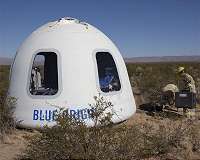
illustration only

Thai satellite and space company mu Space Corp have shipped a payload to an upcoming Blue Origin New Shepard flight to promote space-related activities and collaboration among universities and space agencies in Thailand.

The payload, weighing six kilograms in total, includes several experiments and research, such as:

+ Bleeding Preventive Device. Queen Sirikit National Institute of Child Health has sent a device they developed to prevent profuse bleeding. The institute aims to test the quality of the device after microgravity exposure.

+ Carbon Nanotube. Chulalongkorn University intends to study how space affects the structural and electronic properties of carbon nanotube, a material that is considered to be 100 times stronger than steel.

+ Vacuum-Sealed Food in Microgravity. This experiment aims to know how microgravity affects the texture, taste and smell of food. Geo-Informatics and Space Technology Development Agency (GISTDA), a space agency in Thailand, will use the experiment findings to develop techniques of preparing food to be consumed in space.

The payload also includes a number of items from King Mongkut's Institute of Technology Ladkrabang and National Astronomical Research Institute of Thailand (NARIT). mu Space, on their part, had sent textile materials that they plan to use on the space suit and apparels they will soon develop.

CEO and founder James Yenbamroong said: "The payload will reach 100 kilometers above the Earth's surface. Once in space, the payload will experience a reduced effect of gravity or weightlessness."

"We are excited to join the upcoming New Shepard flight. We are really curious how microgravity affects the structure and properties of things, and we hope this flight will help us understand the science behind it," he added.

Blue Origin was established by Amazon CEO and founder Jeff Bezos with a bold vision to seed an enduring human presence in space. In November 2015, Blue Origin's New Shepard rocket became the first to fly to space and return to Earth via vertical landing.

Less than two months later, the very same rocket launched and landed again, demonstrating reuse - a key enabler to a future in which millions of people are living and working in space.

mu Space, founded in 2017, develops satellite communication technologies to accelerate the adoption of Internet of Things devices and smart cities. It plans to launch its own satellite in 2020 using Blue Origin's New Glenn space vehicle, and to lead space technology development and encourage new space investments in Asia-Pacific.


Related Links
mu Space
The latest information about the Commercial Satellite Industry


Thanks for being here;
We need your help. The Space Media Network continues to grow but revenues have never been harder to maintain.

With the rise of Ad Blockers, and Facebook - our traditional revenue sources via quality network advertising continues to decline. And unlike so many other news sites, we don't have a paywall - with those annoying usernames and passwords.

Our news coverage takes time and effort to publish 365 days a year.

If you find our news sites informative and useful then please consider becoming a regular supporter or for now make a one off contribution.
SpaceMediaNetwork Contributor
$5 Billed Once


credit card or paypal
SpaceMediaNetwork Monthly Supporter
$5 Billed Monthly


paypal only


SPACEMART
Goonhilly targets business expansion in Australia and Asia-Pacific
Cornwall, UK (SPX) Jul 16, 2018
Satellite communications innovator and space gateway, Goonhilly Earth Station, has announced the appointment of Bob Gough as Head of Business Development, Australia and Asia-Pacific. Based in Australia, Gough's role is to spearhead commercial expansion for Goonhilly across the region, develop new business opportunities and grow Goonhilly's customer base. Gough's appointment comes just days after the July 1st establishment of the Australian Space Agency, signalling a major step forward in developin ... read more

Comment using your Disqus, Facebook, Google or Twitter login.


Share this article via these popular social media networks
del.icio.usdel.icio.us DiggDigg RedditReddit GoogleGoogle

SPACEMART
Saudi Arabia intercepts Yemen rebel missile: coalition

US wants Turkey to buy Patriot missiles, not Russian system

Lockheed contracted for Aegis missile defense development

AEGIS Weapons System sale to Spain approved by State Department

SPACEMART
State Department approves sale of AMRAAM missiles to Denmark

Saudi Arabia says Yemen rebel missile intercepted

NATO successfully tests upgraded Sea Sparrow missile

Finnish navy to acquire Gabriel anti-ship missiles

SPACEMART
Israel Patriot missile intercepts unarmed drone from Syria: army

Fire Scout unmanned helicopter finishes first flight tests from LCS

Rolls-Royce awarded $420M contract for drone engines

Facebook halts production of drones for internet delivery

SPACEMART
IntelsatOne FlexAir Coming This Summer for Government Aircraft Operations

Intelsat General Delivers Programming For American Forces Network

Altamira receives $25 million contract for radio frequency research

New Land Mobile Technology Driving The Need For Modern Satcom Capabilities

SPACEMART
U.S. Army to introduce new physical fitness test

Army Futures Command to be located in Austin, Pentagon announces

Honeywell tapped for M1 tank engine refurbishment

Rheinmetall tapped for laser light for Bundeswehr assault rifles

SPACEMART
NATO allies agree to partner for joint weapons purchases

Trump piles pressure on NATO over defence spending

Trump hails 'tremendous progress' on NATO defence spending

NATO summit in crisis over Trump spending demands

SPACEMART
Tornado Trump rips diplomatic swathe across Europe

At historic summit, Trump refuses to confront Putin on vote row

Trump attacks US 'foolishness' heading into Putin showdown

Calling EU a US foe is 'fake news': Tusk barb at Trump

SPACEMART
Physicists uncover why nanomaterial loses superconductivity

Squeezing light at the nanoscale

A new way to measure energy in microscopic machines

AI-based method could speed development of specialized nanoparticles


The content herein, unless otherwise known to be public domain, are Copyright 1995-2024 - Space Media Network. All websites are published in Australia and are solely subject to Australian law and governed by Fair Use principals for news reporting and research purposes. AFP, UPI and IANS news wire stories are copyright Agence France-Presse, United Press International and Indo-Asia News Service. ESA news reports are copyright European Space Agency. All NASA sourced material is public domain. Additional copyrights may apply in whole or part to other bona fide parties. All articles labeled "by Staff Writers" include reports supplied to Space Media Network by industry news wires, PR agencies, corporate press officers and the like. Such articles are individually curated and edited by Space Media Network staff on the basis of the report's information value to our industry and professional readership. Advertising does not imply endorsement, agreement or approval of any opinions, statements or information provided by Space Media Network on any Web page published or hosted by Space Media Network. General Data Protection Regulation (GDPR) Statement Our advertisers use various cookies and the like to deliver the best ad banner available at one time. All network advertising suppliers have GDPR policies (Legitimate Interest) that conform with EU regulations for data collection. By using our websites you consent to cookie based advertising. If you do not agree with this then you must stop using the websites from May 25, 2018. Privacy Statement. Additional information can be found here at About Us.