
Subscribe free to our newsletters via your
. Military Space News .


BIO FUEL
new catalyst makes converting carbon dioxide to useful chemicals cheaper
by Karen B. Roberts
Newark DE (SPX) Feb 01, 2014


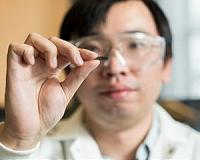
A UD engineering research team led by Feng Jiao has developed a highly selective catalyst capable of electrochemically converting carbon dioxide to carbon monoxide with 92 percent efficiency.

A team of researchers at the University of Delaware has developed a highly selective catalyst capable of electrochemically converting carbon dioxide - a greenhouse gas - to carbon monoxide with 92 percent efficiency. The carbon monoxide then can be used to develop useful chemicals.

"Converting carbon dioxide to useful chemicals in a selective and efficient way remains a major challenge in renewable and sustainable energy research," according to Feng Jiao, assistant professor of chemical and biomolecular engineering and the project's lead researcher.

Co-authors on the paper include Qi Lu, a postdoctoral fellow, and Jonathan Rosen, a graduate student, working with Jiao.

The researchers found that when they used a nano-porous silver electrocatalyst, it was 3,000 times more active than polycrystalline silver, a catalyst commonly used in converting carbon dioxide to useful chemicals.

Silver is considered a promising material for a carbon dioxide reduction catalyst because of it offers high selectivity - approximately 81 percent - and because it costs much less than other precious metal catalysts. Additionally, because it is inorganic, silver remains more stable under harsh catalytic environments.

The exceptionally high activity, Jiao said, is likely due to the UD-developed electrocatalyst's extremely large and highly curved internal surface, which is approximately 150 times larger and 20 times intrinsically more active than polycrystalline silver.

Jiao explained that the active sites on the curved internal surface required a much smaller than expected voltage to overcome the activation energy barrier needed drive the reaction.

The resulting carbon monoxide, he continued, can be used as an industry feedstock for producing synthetic fuels, while reducing industrial carbon dioxide emissions by as much as 40 percent.

To validate whether their findings were unique, the researchers compared the UD-developed nano-porous silver catalyst with other potential carbon dioxide electrocatalysts including polycrystalline silver and other silver nanostructures such as nanoparticles and nanowires.

Testing under identical conditions confirmed the non-porous silver catalyst's significant advantages over other silver catalysts in water environments.

Reducing greenhouse carbon dioxide emissions from fossil fuel use is considered critical for human society. Over the last 20 years, electrocatalytic carbon dioxide reduction has attracted attention because of the ability to use electricity from renewable energy sources such as wind, solar and wave.

Ideally, Jiao said, one would like to convert carbon dioxide produced in power plants, refineries and petrochemical plants to fuels or other chemicals through renewable energy use.

A 2007 Intergovernmental Panel on Climate Change report stated that 19 percent of greenhouse gas emissions resulted from industry in 2004, according to the Environmental Protection Agency's website.

"Selective conversion of carbon dioxide to carbon monoxide is a promising route for clean energy but it is a technically difficult process to accomplish," said Jiao. "We're hopeful that the catalyst we've developed can pave the way toward future advances in this area."

The research team's work is supported through funding from the American Chemical Society Petroleum Research Fund and University of Delaware Research Foundation. Jiao has patented the novel application technique in collaboration with UD's Office of Economic Innovation and Partnerships. Photos by Evan Krape and illustration courtesy of Feng Jiao

.


Related Links
Center for Catalytic Science and Technology
Bio Fuel Technology and Application News


Comment on this article via your Facebook, Yahoo, AOL, Hotmail login.

Share this article via these popular social media networks
del.icio.usdel.icio.us DiggDigg RedditReddit GoogleGoogle


BIO FUEL
Ceresana expects the market for bioplastics to grow
Konstanz, Germany (SPX) Feb 04, 2014
Polypropylene made from sugarcane, polyester based on starch, and polymers using lactic acid as feedstock: Plastics based on renewable resources are increasingly becoming a real alternative to petrochemical products. "Even in times of economic difficulties, bioplastics possess an enormous potential", describes Oliver Kutsch, CEO of the market research institute Ceresana: "Until 2021, deman ... read more


BIO FUEL
Israel to start Arrow 3 production although key test still to come

Raytheon resumes work on US Navy Air and Missile Defense Radar

Israel's Rafael and Raytheon to co-produce Iron Dome

Lockheed Martin Advances Affordability Across U.S. Navy's Aegis Weapons System To Secure Multi-Year Contract

BIO FUEL
Qualification Tests of GMLRS Alternative Warhead Continue

Raytheon receives contract for Ground Based Air Defense System for Oman

US warns Moscow of concern over cruise missile test

Longbow Missiles Demonstrate Littoral Attack Capability

BIO FUEL
Anglo-French accord covers development of drones

Israel's defense industry boosts UAV sales, eyes unmanned subs

US prepares for cyber warfare with mass production of 3D-printed drones

AUVSI Encourages FAA to Allow Limited Small UAS Operations

BIO FUEL
MUOS Satellite Tests Show Extensive Reach In Polar Communications Capability

Space squadron optimizes wideband communication constellations

GA-ASI and Northrop Showcase Unmanned Electronic Attack Capabilities

US Navy Accepts General Dynamics-built MUOS Ground Stations

BIO FUEL
US Army and Lockheed Martin Complete Advanced Autonomous Convoy Demonstration

Northrop Grumman Delivers 100th EA-18G Airborne Electronic Attack Kit

Lockheed Martin Demonstrates Weapons Grade High Power Fiber Laser

Raytheon selected for Next Generation Jammer Electronic Warfare Program

BIO FUEL
Raytheon urges more transatlantic industry cooperation

Asia fuels rise in world defence spending: study

French defense exports grew more than 30 percent in 2013

Officers but not gentlemen: Pentagon's naughty list

BIO FUEL
Philippine leader likens China's rulers to Hitler

Outside View: The Pelosi School of Foreign Policy

Tokyo chides translator over PM Abe's WWI remark: reports

East Sea Fleet expels foreign military planes from China air

BIO FUEL
Physicists at Mainz University build pilot prototype of a single ion heat engine

Quantum dots provide complete control of photons

New boron nanomaterial may be possible

Layered security: Carbon nanotubes promise improved flame-resistant coating


The content herein, unless otherwise known to be public domain, are Copyright 1995-2014 - Space Media Network. AFP, UPI and IANS news wire stories are copyright Agence France-Presse, United Press International and Indo-Asia News Service. ESA Portal Reports are copyright European Space Agency. All NASA sourced material is public domain. Additional copyrights may apply in whole or part to other bona fide parties. Advertising does not imply endorsement,agreement or approval of any opinions, statements or information provided by Space Media Network on any Web page published or hosted by Space Media Network. Privacy Statement