On September 22, 1960, President Eisenhower addressed the United Nations General Assembly and asked, "Will outer space be preserved for peaceful use and developed for the benefit of all mankind? Or will it become another focus for the arms race-and thus an area of dangerous and sterile competition?"
While over 56 years have passed since his remarks, space remains on the precipice of danger. During that time, the United States has led the world in exploiting space for peaceful purposes, championing modern society, enhancing the global commons, and driving the information economy. Yet, dark storm clouds are on the horizon as space becomes more competitive, congested, and contested in recent decades.
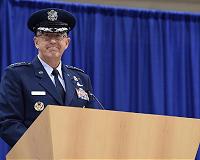
In order to preserve the peace, Air Force senior leaders in the District of Columbia and Gen. John Hyten, then Air Force Space Command commander, developed the Space Mission Force concept. SMF is a paradigm shift in how we operate in space and is being implemented across Air Force Space Command. Above all, SMF is a cultural change.
For years, space warfighters viewed their domain as benign and unchallenged apart from harsh astronomical conditions. That strategic luxury is no longer accurate. Furthermore, SMF is not an evolution, but a revolution in how space warfighters understand, train, and innovate in order to provide the Joint Force with the space capabilities required to deter and defeat our potential adversaries. A key catalyst for this revolution is the integration of intelligence support and advanced training into space squadrons.
Over the past year, the 21st Operations Support Squadron championed SMF readiness and transition within the 21st Space Wing. For example, 21st OSS organized Mission Design Series writing conferences to codify new weapons system training and evaluation processes, revamped an entire training course, established weekly intelligence and tactics integration meetings with 21st SW units, and drove a global $10 million upgrade to facilities.
Additionally, 21st OSS assists an effort to establish advanced training curriculum across the 21st SW. All of these endeavors required continuous coordination with and support from our sister units. Moreover, the 21st OSS collects lessons learned from the units who already began the SMF transition to better support others who are preparing to begin the process.
The 21st SW is already reaping the benefits from this cultural revolution. For instance, keen operators across 10 units submitted 16 tactics improvement proposals to Air Force Space Command, far exceeding any amount in recent years.
Improved crew coordination was documented and tailored intelligence requirement requests were submitted for the first time, pursuing specific threats against current capabilities. These observations illuminate a trend and demonstrate a desire to fully understand potential adversary actions and develop ways to mitigate them.
Finally, SMF is a way to transform, not end, current space systems' agility and survivability to preserve the peaceful utilization of the ultimate high ground. The cultural change observed to date emboldens education, innovation, and critical thinking, which are required to succeed against impending challenges. Most importantly, SMF unleashes the tenacity of our Airmen who remain unparalleled in achieving space superiority for our nation's and the world's security.