|
 |
 |
 |
 |
 |
 |
 |
 |
 |

| . |  |
. |
Iraq out of time, needs troops
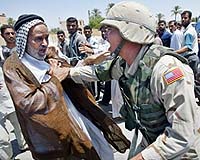
Washington (UPI) Dec 15, 2006 A leading U.S. military analyst is advocating the addition of some 30,000 U.S. forces to Iraq, with a new mission: to protect the Iraqi people. Frederick Kagan, a former instructor at West Point and now a resident scholar at the American Enterprise Institute, believes his plan to add seven Army brigade combat teams and Marine regiments to Baghdad and Anbar province early next year could establish security in Baghdad by the fall of 2007. While much of the focus in Washington is on increasing the pace of American training of Iraqi security forces who will eventually take on the bulk of the fighting, Kagan argues the United States and Iraq no longer has that luxury of time. "Iraq has reached a critical point. The strategy of relying on a political process to eliminate the insurgency has failed. Rising sectarian violence threatens to break America's will to fight. This violence will destroy the Iraqi government, armed forces, and people if it is not rapidly controlled," he writes. "Violence is accelerating beyond the Iraqis' ability to control it." The surge in troops, if it succeeds in turning around the deteriorating situation in Iraq, would pave the way for a major troop withdrawal in 18 to 24 months, he says. But the surge would also would also mean an increase in battle casualties, now nearing 3,000. "Short-term increase in casualties is not a sign of failure ... As troops actively secure the population the enemy will surge its attacks on coalition troops and Iraqi civilians," Kagan writes. He envisions a four-phase strategy in 2007: surging forces into Iraq by March; preparing for "clear and hold" operations by June; clear critical areas by September; and then transition control of them to Iraqi forces. "These forces, partnered with Iraqi units, will clear critical Sunni and mixed Sunni-Shiite neighborhoods, primarily on the west side of the city. After the neighborhoods have been cleared, U.S. soldiers and Marines, again partnered with Iraqis, will remain behind to maintain security," Kagan writes in a new paper for AEI. The clear and hold operation would be closely linked to a U.S. military led-reconstruction package with a fully funded plan in place prior to the battles so they can immediately pick up trash and get water and electricity working, area by area. "Even large reconstruction efforts are cheap compared to continued fighting," he notes. It's an expansion of the tactics used with some success in Tall 'Afar and Fallujah but far more ambitious. Those towns were a fraction of the size of Baghdad and relatively isolated, making them easier to surround, empty and conduct house-to-house searches. Their size and location also allowed the return of residents, and potential fighters, to be managed. Five U.S. brigades are currently operating in Baghdad along with six Iraqi brigades. In Anbar province, there are two Marine regimental combat teams and one U.S. Army brigade combat team. Together, they comprise just 52,500 combat forces in a total U.S. deployment of about 140,000. The remainder are serving in combat service support, headquarters, intelligence and other non-battle functions. Kagan's plan would bring the number of combat troops to 84,000 by September 2007, nearly a 50 percent increase in combat power. Kagan is not alone in advocating a troop increase. Senior military officers who spoke to UPI on condition of anonymity say that having sufficient troops in Iraq to actually quell the insurgency and combat sectarian violence is the one approach the United States has not yet tried. Since the insurgency began in earnest in November 2003, U.S. forces have been playing catch-up, never having quite enough troops to both carry out aggressive offensive operations and to maintain a daily presence in the areas already under control. That has resulted in a nationwide "whack-a-mole" strategy, they said. When they have come down hard on one area, the enemy has squeezed out to somewhere they are not. The training of more than 300,000 Iraqi army and police has provided a "holding" force but their performance has been uneven at best, and in the case of the police, sometimes counterproductive. And the intervening three years has similarly allowed the insurgent and militia forces to grow as well, diminishing the impact Iraqi forces can have. The answer, according to Kagan, is a dramatic increase in the number of U.S. troops assigned to protecting Iraq's civilian population. To get the number of U.S. troops up, Kagan proposes to accelerate the deployment of the next four brigades, now scheduled from April to February. The remaining BCTs would be extended from a 12-month deployment to 15 months. The Marine regiments would be extended from seven months to 12. That would bring the American troops presence in Baghdad up to nine or 10 BCTs, each with about 4,000 soldiers. The plan would also result in two additional Marine regimental combat teams in Anbar province. Kagan would not pull forces from outside of Baghdad into that fight, Rather, he would leave them in place to continue their daily operations -- preventing insurgents and sectarian militias from establishing a foothold in areas previously secured from them. This military version of "robbing Peter to pay Paul" has been played out repeatedly throughout the war, commanders have complained. When they have stabilized an area, troops get called on to put out a fire somewhere else - leaving a security vacuum where they came from and inviting new violence. If the clear and hold plan is carried out in Baghdad in 2007, Kagan writes that in 2008 the U.S. military could help disarm Shiite militias, stabilize Anbar or northern Iraq, and/or continue the training mission. Kagan concedes the potential responses to an invigorated American offensive in Iraq, outlining each factions' likely responses, and the most dangerous short- and long-term scenarios, along with a plan to counter them. Kagan also says the U.S. Army and Marine Corps must add at least 60,000 troops to their pay roll in the next two years and the increase must be permanent. It is "vital to offset increased demand on the ground forces in Iraq, and vital to provide strategic options in many scenarios beyond Iraq," he writes. Army Chief of Staff Gen. Peter Schoomaker said Thursday that the most the Army can hope to recruit above the 80,000 a year it does now is 6,000 to 7,000 additional soldiers. Marine Corps officials believe they can add another 2,000 additional recruits annually. However, the Army and Marine Corps could likely retain far greater numbers of troops than they currently do. Re-enlistments and extensions are at all time highs, particularly among combat units deployed to Iraq. Schoomaker also warned that if he does not get additional troops, and more freedom to use reservists to fill out the force, the Army is in danger of "breaking." Kagan says his plan will not break the Army: only four units would be accelerated to Iraq, and they were tapped to go anyway. Moreover, no unit will have less than a year between deployments under his plan. "Losing now will certainly break the force," Kagan writes. Kagan could not be immediately reached for comment. An AEI spokeswoman said he was at a White House briefing. Related Links Iraq: The first techonology war of the 21st century  Palestinian infighting escalates
 Tel Aviv, Israel (UPI) Dec 15, 2006
 Clashes among Palestinian militants spread Friday after gunmen attacked Prime Minister Ismail Haniyeh's convoy, killing his bodyguard and wounding Haniyeh's son and a close adviser. The prime minister himself was not hurt. |
|
|

| The content herein, unless otherwise known to be public domain, are Copyright 1995-2006 - SpaceDaily.AFP and UPI Wire Stories are copyright Agence France-Presse and United Press International. ESA PortalReports are copyright European Space Agency. All NASA sourced material is public domain. Additionalcopyrights may apply in whole or part to other bona fide parties. Advertising does not imply endorsement,agreement or approval of any opinions, statements or information provided by SpaceDaily on any Web page published or hosted by SpaceDaily. Privacy Statement |