
 |
 |
 |
 |
 |
 |
 |
 |
 |
 |

| . |  |
. |

Newtown PA (SPX) Dec 17, 2010 The Lockheed Martin A2100 commercial communications satellite fleet has achieved a major milestone by accumulating 300 years of successful in-orbit operations. The A2100 satellite series, designed and manufactured at Lockheed Martin Commercial Space Systems (LMCSS), currently consists of 37 commercial communication satellites featuring 1400 transponders with an accumulated lifetime of over 11,000 years of successful operations in orbit. The first A2100 satellite, GE-1 (now known as AMC-1), was launched Sept. 8, 1996 and has surpassed 14 years of service life. BSAT-3b, the most recent A2100 spacecraft, was launched Oct. 28, 2010 for the Broadcasting Satellite System Corporation (B-SAT) of Japan. The satellite was handed over for operation to B-SAT on Dec. 8, 2010. "The easy-to-fly A2100 satellite's tremendous versatility and reliability are based on an incremental approach to implementing new technology, enhancing spacecraft performance while assuming very low risk to the overall mission," said LMCSS President Joseph Rickers. "We're extremely proud of the A2100's Mission Success record and are confident we can continue to provide the same engineering excellence, manufacturing quality and high level of customer satisfaction to our programs and customers around the globe," continued Rickers. Throughout its 52-year history, Lockheed Martin Space Systems Company has built 98 commercial communications geostationary earth orbit satellites which have achieved a total of 921 in-orbit years. The Lockheed Martin A2100 geosynchronous spacecraft series is designed to meet a wide variety of telecommunications needs including Ka-band broadband and broadcast services, fixed satellite services in C-band and Ku-band, high-power direct broadcast services using the Ku-band frequency spectrum and mobile satellite services using UHF, L-band, and S-band payloads. The A2100's modular design features simplified construction, increased on-orbit reliability and reduced weight and cost. The A2100 design accommodates a large range of communication payloads and serves as the platform for critical government communications programs, including the Advanced Extremely High Frequency and Mobile User Objective System satellites. The A2100 spacecraft can also be configured for missions other than communication. It has been adapted for Lockheed Martin's Geostationary Operational Environmental Satellite Series-R earth observing mission and serves as the spacecraft platform for Lockheed Martin's GPS III program.
Share This Article With Planet Earth
Related Links - Space Technology News - Applications and Research

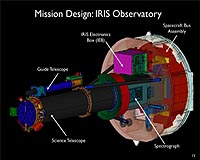 IRIS Passes Critical Design Review
Palo Alto CA (SPX) Dec 17, 2010 The Lockheed Martin team, awarded a contract by NASA in 2009 to design and build the agency's next Small Explorer Mission (SMEX) called the Interface Region Imaging Spectrograph (IRIS), has met the requirements of a Critical Design Review. The review was conducted last week at the Lockheed Martin Space Systems Advanced Technology Center (ATC) in Palo Alto by a group of multi-disciplinary e ... read more |
|
|
| The content herein, unless otherwise known to be public domain, are Copyright 1995-2010 - SpaceDaily. AFP and UPI Wire Stories are copyright Agence France-Presse and United Press International. ESA Portal Reports are copyright European Space Agency. All NASA sourced material is public domain. Additional copyrights may apply in whole or part to other bona fide parties. Advertising does not imply endorsement,agreement or approval of any opinions, statements or information provided by SpaceDaily on any Web page published or hosted by SpaceDaily. Privacy Statement |


 del.icio.us
 Digg
Digg Reddit
 YahooMyWeb
 Google
 Facebook


