|
 |
 |
 |
 |
 |
 |
 |
 |
 |

| . |  |
. |
A Film Of The Heavens
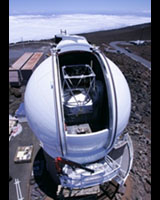
Heidelberg, Germany (SPX) Oct 13, 2006 Astronomers from the Max-Planck-Institutes for Astronomy in Heidelberg and for Extraterrestrial Physics in Garching have joined with colleagues world-wide to form a consortium that will exploit a powerful new survey telescope on Haleakala on the island of Maui (Hawaii). This telescope will map repeatedly much of the entire sky, hence creating a high color-map and the first digital "movie" of the heavens, mapping changes in the sky with time. The PanSTARRS1 Consortium will use data from the University of Hawaii's 1.8 metre PS1 telescope to discover billions of new stars, new planets, galaxies and solar system objects, including potential "killer asteroids" that threaten the Earth. It will also produce the most extensive 3-dimensional map of the Universe ever made. The consortium that will assemble and interpret these maps includes the two institutes of the Max Planck Society in Germany, the University of Hawaii, the Harvard-Smithsonian Center for Astrophysics and the Johns Hopkins University in the USA, plus a group of Universities in the United Kingdom. Together, the consortium will contribute the hardware, software for the telescope and data pipeline, and the cost of operating the survey in Hawaii for 3.5 years. The telescope, which has a 71-inch diameter mirror, achieved "First Light" in June this year. It is currently undergoing engineering tests and will become fully operational in 2007. It will soon be equipped with the world's largest digital camera, under construction at the UH Institute for Astronomy's Manoa headquarters. The camera will have 1.4 billion pixels - about 300 times as many as a typical commercial digital camera, and its field of view will be 7 square degrees large. This extremely large field of view, high sensitivity of the detectors and overall optical quality of the system will allow repeated fast coverage of the entire sky observable from Hawaii. As a consequence of this breakthrough in the size of the field of view and digital detector, an enormous data flow of several terabytes per night will be collected; therefore new solutions for data handling, evaluation and storage have to be developed. The resulting images, once put together as a map and monitoring "movie" of the sky provide a treasure trove of information and a long-lasting legacy archive for a wide range of astrophysical research, which will become available to the world-wide community after completion of the project. Based on these data, researchers at the two Max Planck Institutes will lead a number of central key science projects: The Max Planck Institute for Astronomy in Heidelberg will lead the search for extra-solar planets. The PS1 survey, with its repeated imaging of the same parts of the sky, i.e. its movie mode, could lead to the discovery of 100 planets like Jupiter using the transit method, in which the central star is briefly obscured by the dark planet transiting in front of it. The Max Planck Institute for Astronomy will also lead the construction of an unprecedented 3-dimensional map of our own Milky Way and its surrounding, so as to better understand how our "galactic home" came into existence the Max Planck Institute for Extraterrestrial Physics will lead a research project on the nature of Dark Energy using the evolution of the large-scale distribution of massive galaxies. Dark Energy accelerates the expansion of the universe and its origin is possibly the most fundamental problem of modern physics. Finally, the database generated by the entire PanSTARRS1 survey will provide a large variety of input objects for follow-up studies more powerful telescopes, like the ESO Very Large Telescope in Chile or the Large Binocular Telescope in Arizona. Related Links Max Planck Institute for Astronomy, Heidelberg Stellar Chemistry, The Universe And All Within It  Celestial Siblings Offer Evidence Of Stellar Formation Long Ago
 Urbana-Champaign IL (SPX) Oct 12, 2006
The death of a massive nearby star billions of years ago offers evidence the sun was born in a star cluster, say astronomers at the University of Illinois at Urbana-Champaign. Rather than being an only child, the sun could have hundreds or thousands of celestial siblings, now dispersed across the heavens. |
|
|

| The content herein, unless otherwise known to be public domain, are Copyright 1995-2006 - SpaceDaily.AFP and UPI Wire Stories are copyright Agence France-Presse and United Press International. ESA PortalReports are copyright European Space Agency. All NASA sourced material is public domain. Additionalcopyrights may apply in whole or part to other bona fide parties. Advertising does not imply endorsement,agreement or approval of any opinions, statements or information provided by SpaceDaily on any Web page published or hosted by SpaceDaily. Privacy Statement |