|
 |
 |
 |
 |
 |
 |
 |
 |
 |

| . |  |
. |
Celestial Siblings Offer Evidence Of Stellar Formation Long Ago
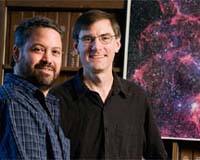
Urbana-Champaign IL (SPX) Oct 12, 2006 The death of a massive nearby star billions of years ago offers evidence the sun was born in a star cluster, say astronomers at the University of Illinois at Urbana-Champaign. Rather than being an only child, the sun could have hundreds or thousands of celestial siblings, now dispersed across the heavens. In a paper accepted for publication in the Astrophysical Journal, astronomy professors Leslie W. Looney and Brian D. Fields, and undergraduate student John J. Tobin take a close look at short-lived radioactive isotopes once present in primitive meteorites. The researchers conclusions could reshape current theories on how, when and where planets form around stars. Short-lived radioactive isotopes are created when massive stars end their lives in spectacular explosions called supernovas. Blown outward, bits of this radioactive material mix with nebular gas and dust in the process of condensing into stars and planets. When the solar system was forming, some of this material hardened into rocks and later fell to Earth as meteorites. The radioisotopes have long since vanished from meteorites found on Earth, but they left their signatures in daughter species. By examining the abundances of those daughter species, the researchers could calculate how far away the supernova was, in both distance and time. The supernova was stunningly close; much closer to the sun than any star is today, Fields said. Our solar system was still in the process of forming when the supernova occurred. The massive star that exploded was formed in a group or cluster of stars with perhaps hundreds, or even thousands, of low-mass stars like the sun, Fields said. Because the stars were not gravitationally bound to one another, the suns siblings wandered away millennia ago. Our solar system, rather than being the exception, could be the rule, the astronomers said. Planetary system formation should be understood in this context. We know that the majority of stars in our galaxy were born in star clusters, Looney said. Now we also know that the newborn solar system not only arose in such a cluster, but also survived the impact of an exploding star. This suggests that planetary systems are impressively rugged, and may be common even in the most tumultuous stellar nurseries. Related Links University of Illinois at Urbana-Champaign Stellar Chemistry, The Universe And All Within It  Are Asteroids Comets And Planets Cut From Same Cloth
 Pasadena CA (SPX) Oct 11, 2006
After analyzing the dust particles of a variety of comets with NASA's Spitzer Space Telescope, the Deep Impact spacecraft and the internationally funded Infrared Space Observatory, Dr. Carey Lisse, of the Johns Hopkins University Applied Physics Laboratory in Laurel, Md., suspects that the answer is yes. |
|
|

| The content herein, unless otherwise known to be public domain, are Copyright 1995-2006 - SpaceDaily.AFP and UPI Wire Stories are copyright Agence France-Presse and United Press International. ESA PortalReports are copyright European Space Agency. All NASA sourced material is public domain. Additionalcopyrights may apply in whole or part to other bona fide parties. Advertising does not imply endorsement,agreement or approval of any opinions, statements or information provided by SpaceDaily on any Web page published or hosted by SpaceDaily. Privacy Statement |