|
 |
 |
 |
 |
 |
 |
 |
 |
 |

| . |  |
. |
A Lack Of Gravity Can Make Us Dangerously Lightweight
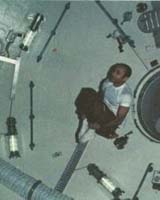
Duluth MN (SPX) Jul 03, 2006 Researchers at the University of Minnesota have identified a way for astronauts to reduce their risk of developing kidney stones while in space. Astronauts lose calcium in their bones and strength in their muscles while in space because of the zero-gravity environment. This calcium can end up in their kidneys, putting them at risk for developing kidney stones. At least 14 American crew members have developed kidney stones in the last 5 years, and as missions become longer, the number is likely to grow. While astronauts have exercised in space to attempt to combat bone loss, the lack of gravity makes it difficult to achieve enough resistance to maintain their pre-flight fitness levels. This becomes a real health concern, as the time astronauts spend in space and living in the space station is extended, said Manoj Monga, M.D., professor of urologic surgery and lead investigator. The study will be published in the July 2006 print issue of the Journal of Urology and is available online now. Kidney stones are mineral deposits in the kidneys that can travel through the urinary tract, causing intense pain. One of the most common types of kidney stones is caused by the buildup of calcium oxalate. Researchers studied the effects of exercise in pairs of identical twins, since a portion of a person s risk for developing kidney stones is genetic. The study participants had no history of kidney stones and were placed on standardized diets. The twins were put on bed rest on a tilted bed that positioned their head lower than their feet to simulate low gravity for 30 days. One twin per pair was randomly selected to exercise (while still reclining) in a chamber that put negative pressure, or resistance on their lower body, and the other twin served as a non-exercising control. The pressure in the chamber was roughly equivalent to what a person would experience running on Earth. Monga found that the non-exercising study participants had higher levels of urinary calcium than the exercising group, and thus had a greater risk of developing kidney stones. Additionally, many astronauts do not drink enough water while in space, so their urine output is lower, and the food they consume is higher in sodium, which also increases the risk for kidney stone development. In combination with hydration therapy, exercise in a machine that simulates gravity could reduce the astronaut s risk of developing kidney stones, a condition that could be particularly painful and lead to an aborted mission, Monga said. Related Links University of Minnesota  NASA Modifies Image Technology To Fight Diabetes
 Greenbelt MD (SPX) Jun 27, 2006
NASA image-processing technology used to explore orbital images of Earth and distant worlds is being modified for diabetes research. Scientists at The George Washington University in Washington, D.C., and Cornell University in Ithaca, N.Y., helped modify the technology, which has greatly increased the speed of the research. |
|
|

| The content herein, unless otherwise known to be public domain, are Copyright 1995-2006 - SpaceDaily.AFP and UPI Wire Stories are copyright Agence France-Presse and United Press International. ESA PortalReports are copyright European Space Agency. All NASA sourced material is public domain. Additionalcopyrights may apply in whole or part to other bona fide parties. Advertising does not imply endorsement,agreement or approval of any opinions, statements or information provided by SpaceDaily on any Web page published or hosted by SpaceDaily. Privacy Statement |