|
 |
 |
 |
 |
 |
 |
 |
 |
 |

| . |  |
. |
A Russian View Of The Quake-Hit Japanese Nuclear Plant
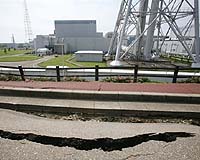
Moscow (RIA Novosti) Jul 25, 2007 An earthquake hit the city of Kashiwazaki in Honshu last week, causing an estimated $33.3 billion worth of damage. The Kashiwazaki-Kariwa nuclear plant, one of Japan's largest, was in the earthquake zone. Radioactive substance leakage is reported. Japanese authorities and public are attacking the Tokyo Electric Power Company after it refused to give information on the danger. The alarm was sounded at the other end of the world, in the headquarters of the International Atomic Energy Agency (IAEA) in Vienna. Dr. Mohamed El Baradei, its Director General, says he hopes TEPCO will not withhold any facts from investigation. Professor Alexei Lopanchuk, an expert on nuclear plants' environmental effects at the Russian Federal Atomic Energy Agency, commented on the situation for RIA Novosti: "I saw a burning transformer on the television. It was no shock to a specialist-a tank transformer can catch fire with the slightest spark. Every project envisages safety measures. Transformers are set apart from each other, so fire cannot spread to cause a leak. Radioactive water could have leaked from the reactor containment sump-but I don't think it could get out of the circuit and pollute the environment, whatever the press might be saying. As for polluted sea, I think that's a paranoid allegation." The expert dismisses speculation that seismic danger was underestimated when the plant site was chosen: "The Japanese are top-notch professionals, and exacting and pragmatic to the utmost degree in choosing plant sites. It was a mere accident, I think." The Kashiwazaki drama makes us wonder whether Russian nuclear plants are immune to natural disasters. They face very little risk from earthquakes on the seismically docile East European Plain. Nonetheless safety measures have been steadily tightened since 2000, when Russia placed a new emphasis on atomic energy. A national wide blue print for updating and enhancing safety procedures has been adopted. All present-day projects are designed to withstand earthquakes with a minimum magnitude of 7 on the Richter scale. Russian specialists proceed from the same stringent safety standards when they build plants abroad. "We design nuclear plants taking account for everything nature can throw at us-tornados, glaze frost, blizzards, torrential rain, earthquakes, tsunamis, landslides and mud volcano eruptions. We also consider every possible man- made risk-for instance, air routes and railroads in the vicinity of plants," Lopanchuk said. Russian-designed projects have proved reliable in the past. The premises and infrastructure of the Kudankulam plant in India stood unscathed in the Sumatran tsunami of 2004. The Armenian plant withstood the force 9 during the 1988 quake, which wiped the town of Spitak off the face of the earth though the plant was designed to withstand a force no greater than 5. Designed and built by Soviet specialists, the Kozlodui plant in Bulgaria survived a sequence of quakes with the epicenter in neighboring Romania. Now, Russia is designing a new Bulgarian nuclear project in Belena, also within the Vrancea seismic zone. The alarmed Japanese public insists on shutting down not only Kashiwazaki, but also Shizuoka and another 15 nuclear power plants out of a total of 55. But this could be expensive. It takes at least a year to cool a reactor in a process that occasionally costs more than plant construction. Furthermore, with no resources comparable to nuclear energy, a shut down may plunge Japan into an energy crisis. "I don't know how accidents are generally estimated. I, for my part, am no alarmist. Japan is accustomed to quakes, and is very serious about them. The damaged units will be re-commissioned after thorough investigation, I am sure," said Professor Lopanchuk. The opinions expressed in this article are the author's and do not necessarily represent those of RIA Novosti.
Source: RIA Novosti Community Email This Article Comment On This Article Related Links Civil Nuclear Energy Science, Technology and News Powering The World in the 21st Century at Energy-Daily.com
 Energy Industry Gears Up For Nuclear Renaissance
 Mcclean Lake (AFP) Canada, July 24, 2007
Twenty years after the Chernobyl disaster poisoned the world's taste for reactors, a French firm is sniffing out fresh uranium supplies in Canada. And the race for nuclear power is back on. After the deadly Chernobyl reactor explosion in Ukraine in 1986 and a lesser scare at the Three Mile Island in Pennsylvania that rattled the United States in 1979, "people were wondering whether nuclear power even had a future," said Yves Dufour, one of the directors of Areva, the world's leading civilian nuclear power provider. |
|
|

| The content herein, unless otherwise known to be public domain, are Copyright 1995-2006 - SpaceDaily.AFP and UPI Wire Stories are copyright Agence France-Presse and United Press International. ESA PortalReports are copyright European Space Agency. All NASA sourced material is public domain. Additionalcopyrights may apply in whole or part to other bona fide parties. Advertising does not imply endorsement,agreement or approval of any opinions, statements or information provided by SpaceDaily on any Web page published or hosted by SpaceDaily. Privacy Statement |