
 |
 |
 |
 |
 |
 |
 |
 |
 |
 |

| . |  |
. |
A Star's Death Cry; Revealing Its Secrets
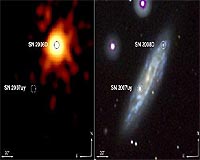
Paris, France (SPX) Aug 26, 2008 A European-led team of international astronomers have discovered clues that suggest that a star that recently went supernova may have exploded more violently than previously thought and collapsed into a black hole. This brutal explosion produced a series of gamma-ray bursts that were only just able to be registered by the astronomers. This discovery could mark an important milestone for astronomers everywhere, as it is providing them with more information of one of the galaxy's most violent events. In the grand cosmic scheme of things, our humble planet and its life-giving star are relatively new kids on the block. In other parts of the Universe, astronomers and other star-gazers are witnessing the swansong of stars that, at their formation, had a mass eight times greater than our own star, the Sun. Recent observations of these stars, as with age they go supernova and explode, is leading scientists to re-evaluate previously held conceptions on the properties of a supernova. The star in question, SN 2008D, was witnessed to have produced a weak jet of gamma-ray bursts, an event which is more commonly attributed to supernovae of a much larger magnitude than that of SN 2008D. These observations were made thanks to the Very Large Telescope of the European Organisation for Astronomical Research in the Southern Hemisphere. 'What made this event very interesting,' said Paolo Mazzali from the Italian National Institute for Astrophysics (INAF), 'is that the X-ray signal was very weak and soft, very different from a gamma-ray burst and more in line with what is expected from a normal supernova.' Astronomers classify X-rays as soft when the relative amount of high-energy X-rays is smaller than that of lower-energy ones. A team of astronomers working in the Asiago Observatory in northern Italy established that event was a Type Ic supernova. 'These are supernovae produced by stars that have lost their hydrogen and helium-rich outermost layers before exploding, and are the only type of supernovae which are associated with (long) gamma-ray bursts. The object thus became even more interesting!' Mazzali enthusiastically explained. Based on the data Mazzali and his team have accumulated and interpreted, they disagree with the opinion of another team of astronomers who state that SN 2008D is a normal supernova. They attribute the detection of X-rays to the fact that this was the very first time astronomers anywhere were lucky enough to catch the star in the act of exploding. What Mazzali and his team believe is that a gamma-ray burst-like inner engine activity exists in all supernovae that form a black hole. Guido Chincarini, co-author and the Principal Investigator of the Italian research on gamma-ray bursts, explains. 'As our X-ray and gamma-ray instruments become more advanced, we are slowly uncovering the very diverse properties of stellar explosions,' she said. 'The bright gamma-ray bursts were the easiest to discover, and now we are seeing variations on a theme that link these special events to more normal ones.' The saga began back in early January 2008, the Swift satellite discovered coming from the vastness of space, a five-minute long burst of X-rays coming from within the spiral galaxy NGC 2770, located 90 million light years away towards the Lynx constellation. The Swift satellite happened to be focusing its attention in that direction because it had been sent to study a supernova that had exploded the previous year in the same galaxy. The satellite is jointly run by the National Aeronautics and Space Administration (NASA) of the USA, the Science and Technology Facilities Council (STFC) of the UK and Agenzia Spaziale Italiana (ASI) of Italy. This discovery further reveals how stars end their lives, producing dense objects, and injecting new chemical elements back into the gas, from which new stars will be formed, continuing the cycle. Community Email This Article Comment On This Article Share This Article With Planet Earth
Related Links European Organisation for Astronomical Research in the Southern Hemisphere Italian National Institute for Astrophysics (INAF) Stellar Chemistry, The Universe And All Within It
 Stellar Still Births
 Bonn, Germany (SPX) Aug 25, 2008
The systematics of celestial bodies apparently needs to be revised. Researchers at the Argelander Institute of Astronomy of the University of Bonn have discovered that brown dwarfs need to be treated as a separate class in addition to stars and planets. |
|
|

| The content herein, unless otherwise known to be public domain, are Copyright 1995-2007 - SpaceDaily.AFP and UPI Wire Stories are copyright Agence France-Presse and United Press International. ESA Portal Reports are copyright European Space Agency. All NASA sourced material is public domain. Additional copyrights may apply in whole or part to other bona fide parties. Advertising does not imply endorsement,agreement or approval of any opinions, statements or information provided by SpaceDaily on any Web page published or hosted by SpaceDaily. Privacy Statement |
 del.icio.us
 Digg
Digg Reddit
 YahooMyWeb
 Google
 Facebook