
 |
 |
 |
 |
 |
 |
 |
 |
 |
 |

| . |  |
. |
Arecibo Joins Global Network To Create 6,000-Mile Telescope
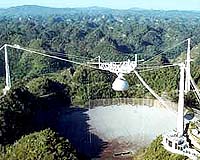
Ithaca, NY (SPX) Jun 12, 2008 On May 22, Arecibo Observatory in Puerto Rico joined other telescopes in North America, South America, Europe and Africa in simultaneously observing the same targets, simulating a telescope more than 6,800 miles (almost 11,000 kilometers) in diameter. The telescopes are all members of the Express Production Real-time e-VLBI Service (EXPReS) project, and May 22 marked a live demonstration of their first four-continent, real-time, electronic Very Long Baseline Interferometry (e-VLBI) observations. VLBI uses multiple radio telescopes to simultaneously observe the same region of sky -- essentially creating a giant instrument as big as the separation of the dishes. VLBI can generate images of cosmic radio sources with up to 100 times better resolution than images from the best optical telescopes. The results were immediately transmitted to Belgium, where they were shown as part of the 2008 Trans-European Research and Education Networking Association Conference. The Arecibo team called the demonstration a major milestone in the telescope's e-VLBI participation, with a data-streaming rate to the central signal processor at the Joint Institute for VLBI in Europe (JIVE) in the Netherlands four times higher than Arecibo had previously achieved. "These results are very significant for the advance of radio astronomy," said JIVE director Huib Jan van Langevelde. "It shows not only that telescopes of the future can be developed in worldwide collaboration, but that they can also be operated as truly global instruments." EXPReS, funded by the European Commission, aims to connect up to 16 of the world's most sensitive radio telescopes to the JIVE processor to correlate VLBI data in real time. This replaces the traditional VLBI method of shipping data on disk and provides astronomers with observational data in a matter of hours rather than weeks, allowing them to respond rapidly to transient events with follow-up observations. Community Email This Article Comment On This Article Share This Article With Planet Earth
Related Links Cornell University Space Telescope News and Technology at Skynightly.com
 Welcome To The Glass Kitchen
 Greenbelt MD (SPX) Jun 12, 2008
It pays to persevere. No one knows this better than Goddard astrophysicist Will Zhang. After 10 years of fine-tuning a technique to efficiently manufacture super-thin, curved mirrors needed to focus X-ray photons, he and his team have won a position on the Caltech-led Nuclear Spectroscopic Telescope Array (NuSTAR) mission to provide the telescope's more than 3,000 individual mirror segments - a level of work estimated at $6.1 million. |
|
|

| The content herein, unless otherwise known to be public domain, are Copyright 1995-2007 - SpaceDaily.AFP and UPI Wire Stories are copyright Agence France-Presse and United Press International. ESA Portal Reports are copyright European Space Agency. All NASA sourced material is public domain. Additional copyrights may apply in whole or part to other bona fide parties. Advertising does not imply endorsement,agreement or approval of any opinions, statements or information provided by SpaceDaily on any Web page published or hosted by SpaceDaily. Privacy Statement |
 del.icio.us
 Digg
Digg Reddit
 YahooMyWeb
 Google
 Facebook