|
 |
 |
 |
 |
 |
 |
 |
 |
 |

| . |  |
. |
Asteroid Shower
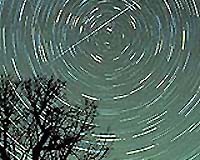
Huntsville AL (SPX) Dec 05, 2007 Mark your calendar: The best meteor shower of 2007 peaks on Friday, December 14th. It's the Geminid meteor shower," says NASA astronomer Bill Cooke of the Marshall Space Flight Center. "Start watching on Thursday evening, Dec. 13th, around 10 pm local time," he advises. "At first you might not see very many meteors-but be patient. The show really heats up after midnight and by dawn on Friday, Dec. 14th, there could be dozens of bright meteors per hour streaking across the sky." The Geminids are not ordinary meteors. While most meteor showers come from comets, Geminids come from an asteroid-a near-Earth object named 3200 Phaethon. "It's very strange," says Cooke. How does an asteroid make a meteor shower? Comets do it by evaporating. When a comet flies close to the sun, intense heat vaporizes the comet's "dirty ice" resulting in high-speed jets of comet dust that spew into interplanetary space. When a speck of this comet dust hits Earth's atmosphere traveling ~100,000 mph, it disintegrates in a bright flash of light-a meteor! Asteroids, on the other hand, don't normally spew dust into space-and therein lies the mystery. Where did Phaethon's meteoroids come from? One possibility is a collision. Maybe it bumped against another asteroid. A collision could have created a cloud of dust and rock that follows Phaethon around in its orbit. Such collisions, however, are not very likely. Cooke favors another possibility: "I think 3200 Phaethon used to be a comet." Exhibit #1 in favor of this idea is Phaethon's orbit: it is highly elliptical, like the orbit of a typical comet, and brings Phaethon extremely close to the sun, twice as close as Mercury itself. Every 1.4 years, Phaethon swoops through the inner solar system where repeated blasts of solar heat could easily reduce a flamboyant comet to the rocky skeleton we see today. If this scenario is correct, Phaethon-the-comet may have produced many rich streams of dust that spent hundreds or thousands of years drifting toward Earth until the first Geminid meteors appeared during the US Civil War. Since then, Geminids have been a regular shower peaking every year in mid-December. 3200 Phaethon is now catalogued as a "PHA"-a potentially hazardous asteroid whose path misses Earth's orbit by only 2 million miles. It measures 5 km wide, about half the size of the asteroid or comet that wiped out the dinosaurs 65 million years ago, and can be seen through backyard telescopes-in fact, now is a good time to look: "3200 Phaethon is flying past Earth just a few days before this year's Geminid meteor shower," notes Cooke. On Dec. 10th, Phaethon will be about 11 million miles away shining like a 14th magnitude star in the constellation Virgo: ephemeris. That's too dim for the naked eye, he says, but a good target for amateur telescopes equipped with CCD cameras. Cooke doesn't expect the flyby to boost the Geminids-"11 million miles is too distant to affect meteor rates"-but the Geminids don't really need boosting. "It's always a great shower," he says. "Don't miss it." Community Email This Article Comment On This Article Related Links NASA Meteoroid Environment Office Asteroid and Comet Mission News, Science and Technology
 Predicting Apophis' Earth Encounters in 2029 and 2036
 Pasadena CA (JPL) Nov 26, 2007
Researchers at NASA/JPL, Caltech, and Arecibo Observatory have released the results of radar observations of the potentially hazardous asteroid 99942 Apophis, along with an in-depth analysis of its motion. The research will affect how and when scientists measure, predict, or consider modifying the asteroid's motion. |
|
|

| The content herein, unless otherwise known to be public domain, are Copyright 1995-2006 - SpaceDaily.AFP and UPI Wire Stories are copyright Agence France-Presse and United Press International. ESA PortalReports are copyright European Space Agency. All NASA sourced material is public domain. Additionalcopyrights may apply in whole or part to other bona fide parties. Advertising does not imply endorsement,agreement or approval of any opinions, statements or information provided by SpaceDaily on any Web page published or hosted by SpaceDaily. Privacy Statement |